
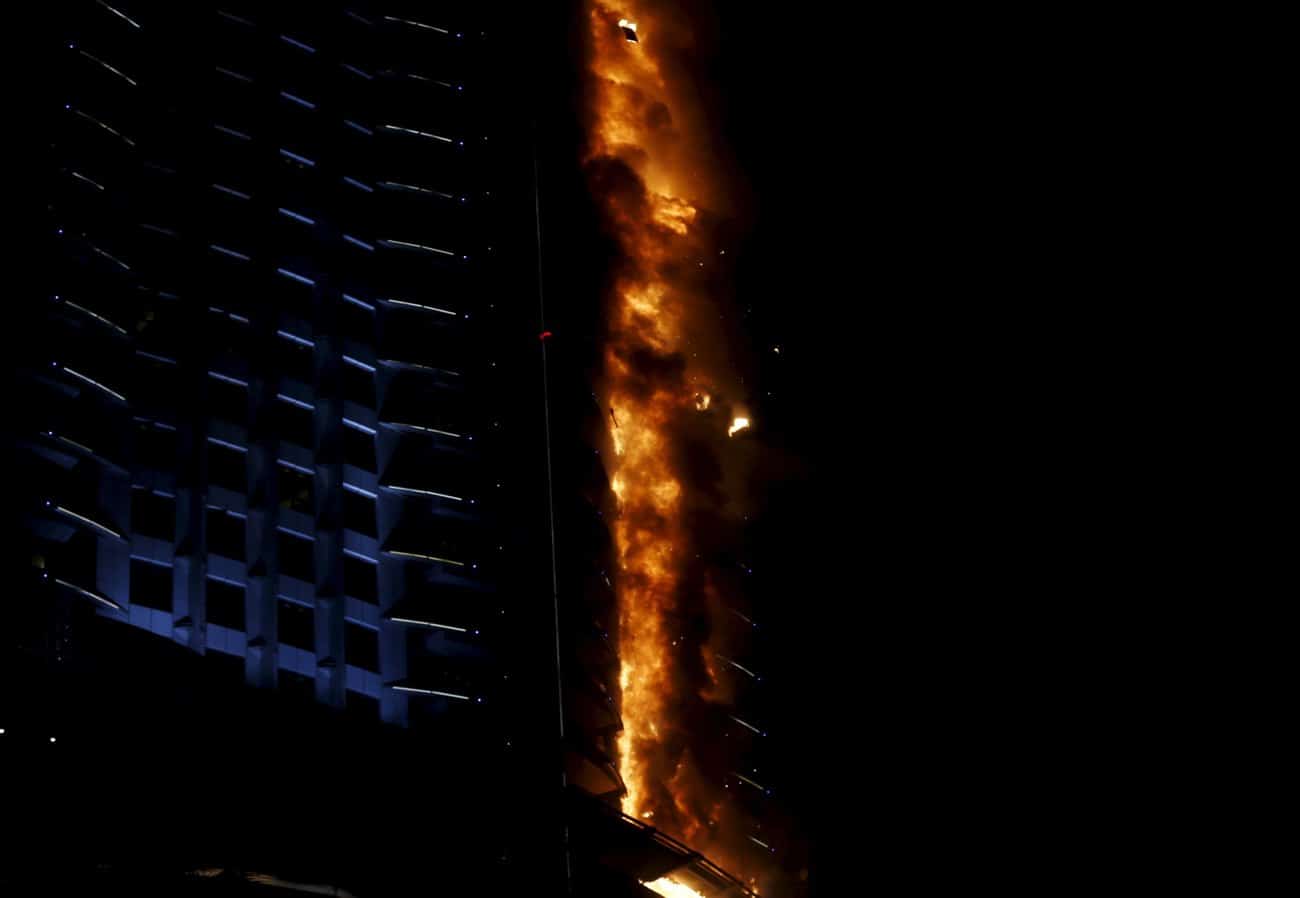
The life-threatening problem of flammable external cladding panels on modern high rise tower blocks raised its ugly head again when fire broke out on a 30 storey residential tower in Ajman, UAE, at 2145 hrs on Monday 28 March 2016.
The fire originated in Tower Six of the Ajman One complex and quickly spread to affect two identical adjacent towers. Civil Defence fire crews from Ajman and nearby Sharjah tackled the fire whilst a full evacuation of residents took place.
The fires were finally contained in the early morning, although firefighters remained in attendance cooling the fire-damaged structure and the contents of many badly damaged apartments for many hours.
Ajman One complex consists of a group of 12 identical towers providing some 3,000 apartments. The total development cost AED 2.7bn (GBP £515m; US$ 735m).
This serious outbreak follows on from that on New Years Eve 2015 in Dubai’s Address Downtown Hotel, whilst there were similar high-rise fires in Dubai in February 2015 at the 86 storey Torch residential tower, and at the Tamweel Tower in November 2012.
The cause of the Ajman Tower outbreak is still under investigation, but there is a strong likelihood that given the previous similar tower outbreaks in the UAE, that the fire was spread by the use of flammable external aluminium composite panels (ACP’s).
In all the recent UAE tower fires, ACP’s rapidly spread the flames both upwards and downwards, due to their ‘sandwich’ filling of a flammable polyurethane and other foam-based material. The use of ACP’s was banned by government regulation in 2013, when UAE Civil Defence announced an extension to existing fire safety codes requiring owners of high-rise towers with flammable cladding panels to install a ring of fire retardant panels on every third floor to stop fire spread, together with external sprinklers and drenchers.
However, many of the UAE’s newer towers – including 200 plus in Dubai alone – were completed in the boom years before the 2013 ban, and in the meantime must be considered vunerable to the risk of fire so graphically demonstrated once again by the Ajman fire.
Fortunately, there were few casualties given the number of residents in the tower at the time of the fire. Brigadier Shaikh Sultan Bin Abdullah Al Nuaimi, Commander-in-Chief of Ajman Police, said five people sustained minor injuries and were treated at the site and a pregnant woman was rushed to Shaikh Khalifa Hospital.
Top Image: A fire engulfs The Address Hotel in downtown Dubai in the United Arab Emirates December 31, 2015. REUTERS/Ahmed Jadallah
About the Author

Neil Wallington is a former British Chief Fire Officer, a Past International President of the Institution of Fire Engineers, and a holder of the Queen’s Commendation for Brave Conduct. He is the author of 17 books on the work of the fire service, and acts as a consultant with extensive experience in the Gulf on a range of projects.
