
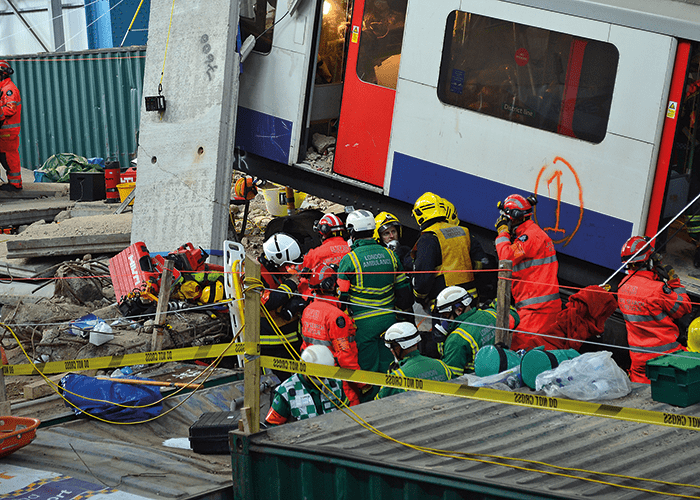
Emergency crews and more than 70 other organisations have taken part in the four-day exercise to test contingency planning in what has been billed as Europe’s biggest disaster training exercise. Exercise Unified Response, coordinated by the London Fire Brigade, simulated a tower block collapsing into Waterloo station to prepare specialist emergency crews for a large-scale operation with mass casualties.
The four-day exercise commenced on Monday 29th February, and was designed to test the contingency planning of more than 70 organisations, from mortuaries to the Government’s Cobra committee, local councils and search and rescue teams. It was staged at a disused power station near the Dartford Crossing as well as at four separate venues in central and south east London.
The drill, which has cost £770,000 and was funded by the European Union, involves eight real tube carriages, tons of rubble and more than 2,000 volunteers playing casualties, bystanders and worried relatives. One carriage was buried so deep in the rubble that emergency crews did not immediately see it.

The request for assistance to the Emergency Response Coordination Centre was be made through the UK’s official channels, including the Cabinet Office.
As crews first arrived on the scene, they were confronted with tube ticket barriers smeared with blood. Casualties, whose injuries had been realistically created by local make up artists, were suffering from a range of head injuries, lacerations, glass wounds, broken legs and amputations.
Disaster victim identification (DVI) teams from all UK police regions worked alongside other forensic specialists. More than 250 personnel worked at the scene and in a specially constructed temporary mortuary. It was the biggest multi-agency training exercise in London Fire Brigade’s history.
Ron Dobson, London Fire Brigade’s Commissioner, described tube tunnels as “the worst place possible” for rescues, with moving trains and live wires adding to the danger.
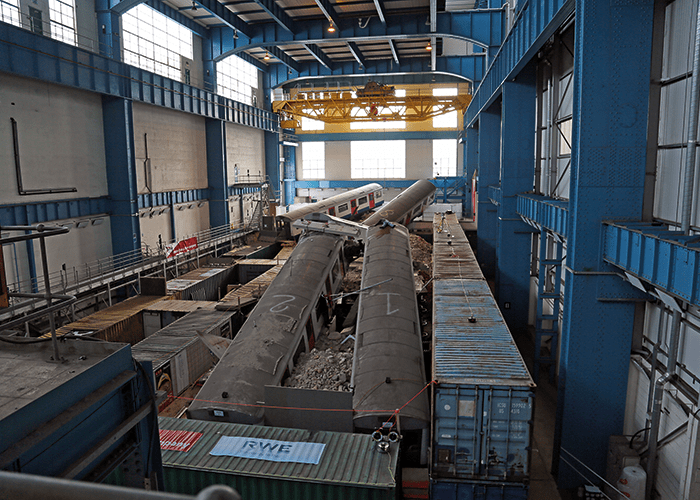
He told the Evening Standard: “We needed to create a realistic scenario, with hundreds of thousands of tons of rubble. The idea was that there’s been the collapse of a high-rise building above Waterloo station that’s gone down into the station itself and caused some collapse into the tunnels. There were some Underground trains caught up in it and people trapped. There’s lots of other hazards we need to be careful of. In something like 7/7 you have to take casualties from the tube train, along the lines and out the platforms.”
Chief Constable Debbie Simpson, of the National Police Chiefs, said: “Victim identification is never a pleasant subject to discuss but it is unfortunately a reality. When disaster strikes families need to be confident that the authorities are doing everything they can to identify their loved ones in a dignified and respectful way, whilst supporting any criminal investigation.”
“Importantly this process cannot be hurried. As frustrating as this can sometimes be, especially in a world of fast paced mainstream and social media, we have to be meticulous in our approach to ensure we achieve reliable scientific identification.”
In recent years, specially trained teams from around the UK have been deployed to assist in the downing of Malaysia Airlines Flight MH17 in July 2014 and the Shoreham air crash in August last year.
For more information, go to www.london-fire.gov.uk
About the Author

Neil Wallington is a former British Chief Fire Officer, a Past International President of the Institution of Fire Engineers, and a holder of the Queen’s Commendation for Brave Conduct. He is the author of 17 books on the work of the fire service, and acts as a consultant with extensive experience in the Gulf on a range of projects.
