
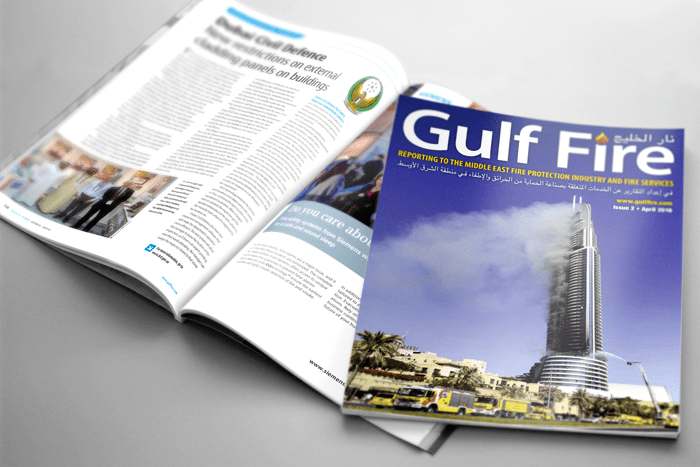
I am pleased to relate that the official launch of Gulf Fire successfully took place during the Intersec three day event in Dubai in mid-January. The magazine was very well received by visitors and exhibitors alike during the Intersec show, which as in every year since its inception has seen an increase in the number of both exhibitors and visitors.
The Intersec event has now become a global show in every sense of the word. Indeed, the strong international flavour and growth of the annual showpiece was underlined by the presence of no fewer than 16 country pavilions exhibiting fire safety and firefighting & rescue technology and related innovative products. They included stands from Canada, China, France, Germany, Hong Kong, India, Italy, Korea, Pakistan, Singapore, Taiwan, UAE, UK, USA and, for the first time, Iran, and the Czech Republic.
Throughout the Intersec event, it was pleasing to meet a number of our readers and advertisers and receive complimentary remarks regarding the style and content of the magazine. The Gulf Fire team much appreciate the support we received. Looking to the future, we will continue to develop the editorial coverage of the wide spectrum of contents from fire protection through to the work of front line firefighting and rescue teams across the region.
The launch edition of Gulf Fire contained a three page focus on Dubai Civil Defence (DCD) and its fire safety and firefighting & rescue work. Their stand at Intersec truly reflected some of the innovative technology that DCD are using to protect Dubai’s ever-growing population from the danger and ravages of fire.
During Intersec, MDM Publishing Ltd presented DCD’s Director General, Major General Expert Thani Al Matroushi, FIFireE, with a specially mounted frame containing all three pages of the Focus on DCD Article as a mark of appreciation of the co-operation readily received from the Major General and his staff.
By way of media and social networks the dramatic outbreak of fire at the Address Downtown Hotel tall tower on New Year’s Eve certainly focussed global attention on Dubai.
At around 2130 hrs on New Year’s Eve, a fire broke out in one of the tower’s external aluminium composite panels (ACP’s) at 15th floor level of the 63 storey Address Downtown Hotel. The 991 ft high tall tower was completed in 2008 at a cost of GBP£156 million, and is close to the Burj Kalifa Tower, the world’s tallest building. The hotel has 196 rooms and 626 apartments. The fire spread very rapidly to engulf most of the ACP’s on one of the hotel’s external faces as units of Dubai Civil Defence quickly arrived to get to work.
The principle concern of the fire risk of ACP’s is their propensity to spread fire very rapidly, both upwards and downwards, due to their ‘sandwich’ filling of a flammable polyurethane and other foam-based material. The use of ACP’s was banned by government regulation in 2013, when UAE Civil Defence announced an extension to existing fire safety codes requiring owners of high-rise towers with flammable cladding panels to install a ring of fire retardant panels on every third floor to stop fire spread, together with external sprinklers and drenchers.
However, many of Dubai’s 200 – plus tall towers were completed before the 2013 ban, and in the meantime must be considered vunerable to the risk of fire so graphically demonstrated by this most recent outbreak.
This inbuilt risk was further underlined by the fact that The Address Downtown fire was the third such occurrence involving a Dubai tall tower since 2013 where ACP’s clearly contributed to a rapid fire spread, both up and down the face of the buildings. Previous fires were in February 2015 at the 86 storey Torch residential tower, and at the Tamweel Tower in November 2012.
Dubai Police have recently confirmed that the fire at the Address Downtown Hotel tower on New Year’s Eve 2015 was caused by electrical fault. According to investigators, an electrical short circuit in a spotlight between the 14th and 15th floors which was used to illuminate the hotel was the origin of the fire.
Thankfully, owing to the prompt action of Dubai Civil Defence firefighters, no deaths were attributed to the fire, although 15 persons were injured and one man suffered a heart attack during the evacuation process.
Once again I make no apology in stating that fire has a habit of regularly reminding us that in an uncontrolled form, it can be one of man’s most deadly enemies. This is exactly why the science and application of modern fire safety and protection has never been more important in safeguarding life and property in communities, commerce and industry not just in the Middle East region, but around the world.
I know only too well from my personal firefighting experience in central London and elsewhere that the physical challenges for fire crews that are involved in tackling an outbreak of fire in a high rise tower are immense.
Tall tower firefighting is a constant topic that engages the attention of firefighters around the globe. Future pages of Gulf Fire will share the various experiences, lessons learnt and best practice of high rise firefighting and rescue incidents. As more and more tall towers reach for the sky, especially in the Gulf and wider Middle East, this is a theme that will undoubtedly continue to be highlighted in the magazine.
About the Author

Neil Wallington is a former British Chief Fire Officer, a Past International President of the Institution of Fire Engineers, and a holder of the Queen’s Commendation for Brave Conduct. He is the author of 17 books on the work of the fire service, and acts as a consultant with extensive experience in the Gulf on a range of projects.
