Exploring the science of sweat and keeping heroes unhindered.
In the realm of firefighting, every innovation in protective gear holds the potential to save lives. With the advent of modern building materials contributing to fires that burn hotter and faster, the risks faced by emergency responders have escalated. Now, more than ever, ensuring firefighter performance, comfort and safety is paramount.
In response to this critical issue, Fire-Dex, a leader in firefighter protective apparel, has introduced new turnout gear that empowers everyday heroes to confront challenges with greater resilience and return home safely after their mission.
At the heart of this innovation lies groundbreaking ventilation technology, enabling wearers to regulate their core body temperature more effectively. Unlike the industry’s previous attempts at ventilation, this dynamic system operates as a one-way street, promoting airflow to facilitate sweat evaporation without compromising the gear’s protective function, thereby addressing the risk of heat-stress-related incidents, the number one cause of line-of-duty deaths for firefighters.
Turning up the heat
Modern construction materials such as plastics, foams and composites often incorporate synthetic components that are more flammable than traditional materials like wood or masonry. These tend to burn hotter and faster, releasing toxic gases and producing intense heat. Additionally, building design has evolved to prioritize factors like energy efficiency and cost-effectiveness. As a result, structures are often built with open floor plans and larger windows, which can contribute to rapid fire spread and increased intensity.
By prioritizing heat and moisture management alongside traditional protective features, manufacturers like Fire-Dex are revolutionizing turnout gear design, ultimately safeguarding those who bravely serve on the front lines where the ability to effectively manage heat and moisture can mean the difference between life and death.
The science behind sweat
This is where Resistance to Evaporative Transfer (Ret) emerges as a critical metric for evaluating turnout gear, alongside more familiar metrics like Total Heal Loss (THL) and Thermal Protective Performance (TPP). Ret testing assesses how well a garment facilitates the evaporation of sweat, thereby influencing the body’s cooling efficiency. Notably, athletic clothing and accessory companies have also adopted Ret testing in their product development processes, allowing them to engineer apparel that optimizes sweat evaporation.
When the body is subjected to heat, it responds by sweating. Sweat, when it evaporates from the skin’s surface, carries away heat, thus cooling the body. This process is vital for maintaining thermal equilibrium and preventing heat-related illnesses.
However, when firefighters don layers of clothing designed to shield them from external heat sources, this natural cooling mechanism is hindered. Turnout gear is engineered to block radiant, convective and conductive heat transfer, thus impeding the body’s cooling process and emphasizing the necessity for sweat to have a proper exit route.
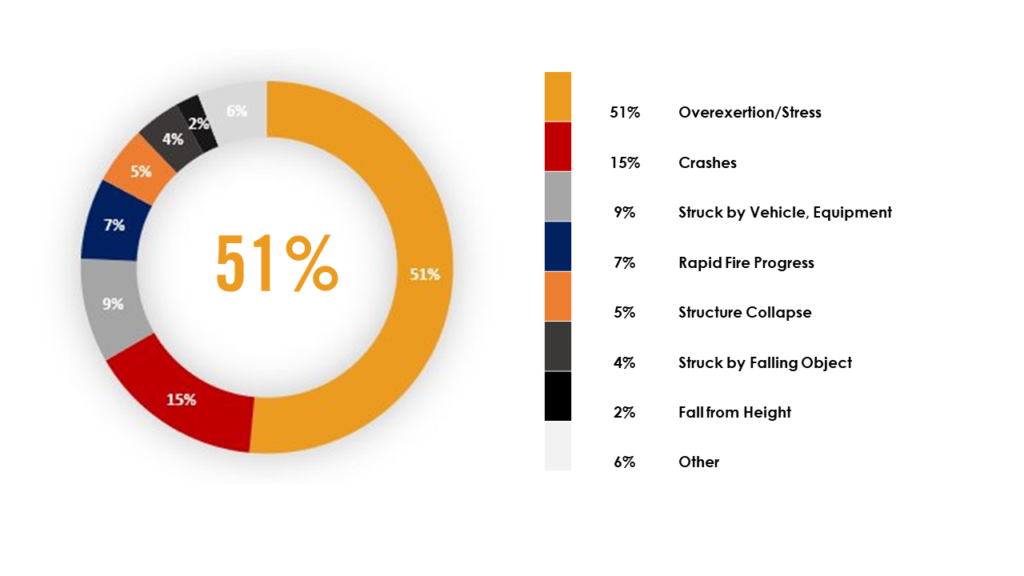
According to NFPA statistics1 for Firefighter Deaths by Cause of Injury in 2022, a staggering 51% of Line-of-Duty Deaths (LODDs) are attributed to overexertion/heat stress, underscoring the urgent need for innovative protective gear designed to effectively mitigate heat stress.
Cooling to the core
Turnout gear has traditionally focused on providing robust protection against external hazards, often at the expense of breathability and heat management. However, advancements in material science and garment engineering have paved the way for vented ensembles that strike a balance between protection and comfort.
Achieving effective venting in turnout gear is no small feat. It requires meticulous consideration to ensure that airflow is optimized without compromising protective properties. One of the key challenges lies in maintaining the gear’s overall moisture and heat integrity while allowing for airflow.
‘The industry has attempted vented thermal liners or outer shells, but achieving simultaneous moisture barrier ventilation has been a major challenge,’ explains Todd Herring, Fire-Dex’s Vice President of Product Innovation and Strategy. ‘The problem lies in creating a system that allows air to flow out for cooling while preventing external elements from infiltrating.’
‘Fire-Dex has pushed the boundaries of turnout gear design by integrating its proprietary AeroVent™ Technology into their new AeroFlex™ suit. This approach involves creating a one-way airflow path that expels heat and moisture from within the garment and prevents liquid and contaminant ingress at the same time – accomplished through a combination of advanced materials, strategic vent placement and exclusive construction techniques.
‘With AeroFlex™, we create a micro-climate within the gear that consistently maintains a pressure differential to the outside environment, so it can breathe while creating an effective barrier against water, heat and impurities. Venting through all layers of the thermal liner and moisture barrier is the key to performance and something that hasn’t been achieved until now.’
Testimonials
Testimonials from firefighters who participated in AeroFlex™ wear trials attest to its effectiveness in combating heat stress. Battalion Chief Chad Christenson of the L.A. County Fire Department remarked on the immediate cooling sensation experienced while wearing AeroFlex™ turnouts during intense firefighting scenarios:
‘I am amazed at how cool it felt. I tried on several occasions to saturate myself with as much convective and radiant heat as possible, then when I moved around, I actually started to cool off. This has never happened in any other set of gear I have worn. The technology is amazing.’

Technically brilliant protection
Within the AeroFlex™ suit is a breathable VaporLite™ Panel three-layer composite system, strategically placed in areas of the body prone to heat accumulation – the inner thighs, armpits, side seams and behind the knees. The vents enhance cooling precisely where it’s needed most, allowing sweat to evaporate more efficiently than any garment available to the fire services today. As a result, firefighters are able to experience rapid cooling upon exiting a high-temperature environment and thereby improving their post-exertion rehab.
‘By promoting airflow through dynamic movement, the technology generates a constant cooling sensation,’ says Herring. ‘As the wearer becomes more active, increased air circulation within the garment results in a heightened cooling experience. The fabric is also working to draw sweat away from the skin to aid evaporation through rapid wicking, so the body can better self-regulate.’
Together, these patent-pending technologies from Fire-Dex deliver Resistance to Evaporative Heat Loss (Ret) values as low as 15 and Total Heat Loss (THL) performance as high as 348, as demonstrated in a composite performance review inclusive of leading competitor panels.
Moreover, Fire-Dex’s commitment to firefighter safety extends beyond heat dissipation. AeroFlex™ turnout gear further integrates particulate-blocking technology into the vents, acting as a barrier against potentially harmful carcinogens. Additionally, the turnout gear incorporates optimized shoulder seams, knee panels and leg openings to align with the body’s natural hinge points, creating minimal coat rise, enhanced flexibility and greater ease of donning and doffing boots.

Cooler, safer gear
As firefighters gear up, they’re not just preparing for battle against flames; they’re equipping themselves with a shield against exertion and unseen dangers. With AeroFlex™ leading the charge, Fire-Dex is seeking not only to redefine comfort in the line of duty but has also craft a defence against the silent threats that linger in the aftermath of every blaze.
As the leading cause of LODDs, heat stress demands proactive measures, and confronting the challenge requires a strong commitment to serving those who serve. For Fire-Dex, it’s about introducing a new era in comfort, safety and resilience, ensuring that everyday heroes return home safely after every call.
For more information, go to http://www.firedex.com/aeroflex
References
About the Author

Todd Herring is the Vice President of Product Innovation and Strategy at Fire-Dex, with over 20 years of experience in the protective textile industry. Passionate about innovating fire service personal protective equipment (PPE), Todd joined Fire-Dex in 2015 through the acquisition of TECGEN. He advanced to Director of Marketing and Product Development in 2016 and was elevated to his current role in 2021. Todd holds a Bachelor of Science in Textile Engineering from NC State University, excelling in product development, management, marketing, rationalization, and strategy. He is based in Medina, Ohio.