

In high-sensitivity smoke detection systems, actual performance is determined not only by detection sensitivity, but also by how effectively the system is adapted to the dust, humidity, temperature and contaminant load of its operating environment.
Detecting a fire at the earliest possible stage is critical for data centres, energy facilities, archives, manufacturing areas, cold-storage facilities and buildings housing high-value assets. However, as detection sensitivity increases, the influence of environmental conditions on system performance also becomes more significant.
Airborne dust, water droplets, condensation, metallic particles, fibres and sudden temperature fluctuations may affect detection stability, increase maintenance requirements and cause unwanted alarm behaviour when they are not taken into consideration during system design. Aspirating smoke detection systems should therefore not be regarded as consisting solely of a high-sensitivity detector.
Sampling pipes, sampling points, filters, water traps, heaters, airflow, alarm thresholds and the maintenance approach should be considered together as components of an integrated engineering solution.
Established Expertise in Fire Detection Technologies
Founded in Istanbul in 1987 to manufacture fire and gas detection systems, Mavili Elektronik brings together product development, electronics manufacturing, system design and project-based engineering activities under a single area of expertise. The company supplies its own Maxlogic & Mavigard branded solutions in Türkiye and more than 80 countries, supporting its approach to developing products in compliance with international standards through pre-sales and after-sales technical services.
The Maxlogic High-Sensitivity Aspirating Smoke Detector was developed as a result of Mavili Elektronik’s engineering experience in fire detection. The product family is designed to be adapted both to sensitive areas where fire must be identified at the earliest possible stage and to challenging applications exposed to environmental factors such as dust, humidity, condensation, low temperatures and metallic particles.
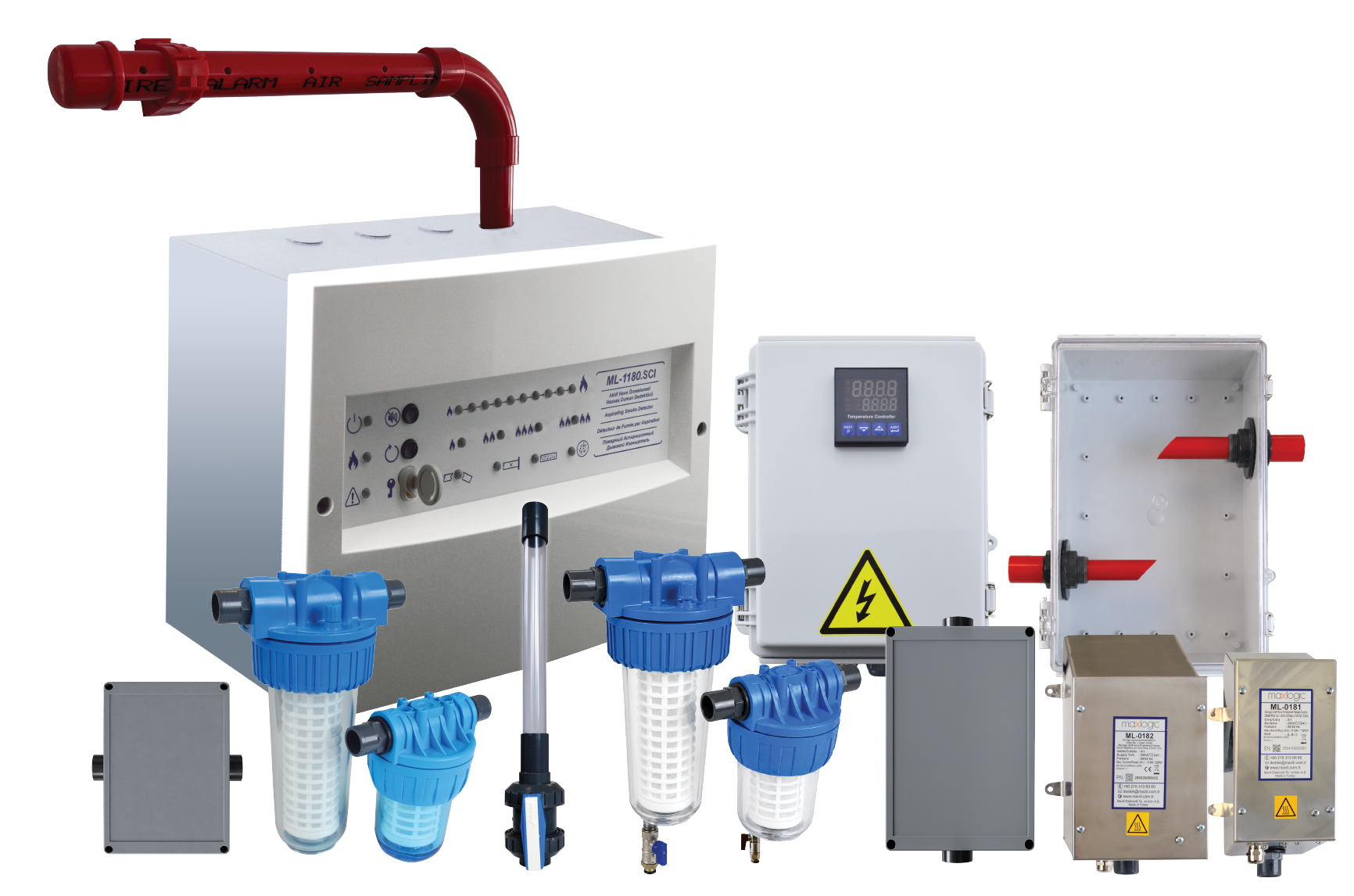
With intelligent addressable and conventional model options, different sensitivity classes, staged alarm levels, and filtration and sample-air conditioning accessories that can be selected according to the application conditions, the system provides not only a high-sensitivity detector but also an integrated smoke detection solution that can be configured for different risk profiles.
Continuous Analysis of Air from the Protected Area
Aspirating smoke detectors transport air from the protected area to the detection unit through a sampling pipe network. Air continuously drawn through sampling holes located along the pipes is analysed within the detector’s sensing chamber.
With this approach, the system does not wait for smoke to reach a ceiling-mounted point detector. Instead, air from the protected area is transported to the detection unit in a controlled manner. This provides an effective detection method, particularly in buildings where fire must be identified at a very early stage, ceiling heights are considerable or access to conventional detectors is difficult.
The Maxlogic High-Sensitivity Aspirating Smoke Detector provides a wide detection range from 0.005% to 20% obs/m and a sensitivity resolution of 0.0001% obs/m. The system can be configured to operate in Class A, Class B and Class C sensitivity classes in accordance with EN 54-20. The intelligent addressable model with an integrated short-circuit isolator has been developed in compliance with EN 54-17.
This wide operating range enables the system to be configured for different application requirements, from sensitive areas requiring very early warning to industrial spaces where environmental influences are more intensive.
More Than a Single Alarm Point
Fire development does not progress at the same rate in every application. In a data centre, it may be necessary to identify very low concentrations of smoke before visible flames occur, whereas in a dusty industrial area, the priority may be to distinguish environmental influences accurately from signs of fire.
A single alarm threshold may therefore not be sufficient for every facility and every scenario. Four different alarm levels can be defined within the Maxlogic system: Warning, Pre-Alarm, Alarm 1 and Alarm 2. This structure enables the fire-safety scenario to be implemented in stages.
At the first level, technical personnel may be instructed to investigate the situation. As the smoke concentration increases, the fire detection and alarm system, building management system, ventilation system or other safety functions may be activated. At higher alarm levels, critical procedures such as evacuation, power isolation, smoke control or extinguishing may be initiated, depending on the facility’s risk profile.
The intelligent addressable model can communicate with the fire detection and alarm system and be directly incorporated into predefined automation scenarios. With the conventional model, various control operations can be performed through alarm and fault relays. Adjustable fan speeds support the optimisation of the system according to the sampling pipework and application conditions.
A topic just as important as sensitivity: Environmental Conditions
In aspirating systems, the pipe network carries not only smoke from the protected area but also other particles contained in the ambient air. The reliability of the system is therefore closely related to how effectively the sampled air is conditioned before it reaches the detector.
The conditions within a clean, climate-controlled data centre are not the same as those in a cement plant, textile production area, cold-storage facility or metalworking plant. Auxiliary equipment should therefore not be selected merely by classifying the environment in general terms as “dusty” or “humid”. The type of contaminant present and the operating conditions of the facility must also be analysed.
Auxiliary devices developed for the Maxlogic product family are designed as part of the overall system to help manage environmental influences including dust, coarse debris, metallic particles, humidity, condensation and low temperatures.
Staged Filtration for Dusty Environments
The type, concentration and particle size of airborne dust vary between industries. Fibrous or larger particles may be more prevalent in wood, textile and paper production, while cement production, mining, stone processing and blasting areas may generate a denser load of fine dust.
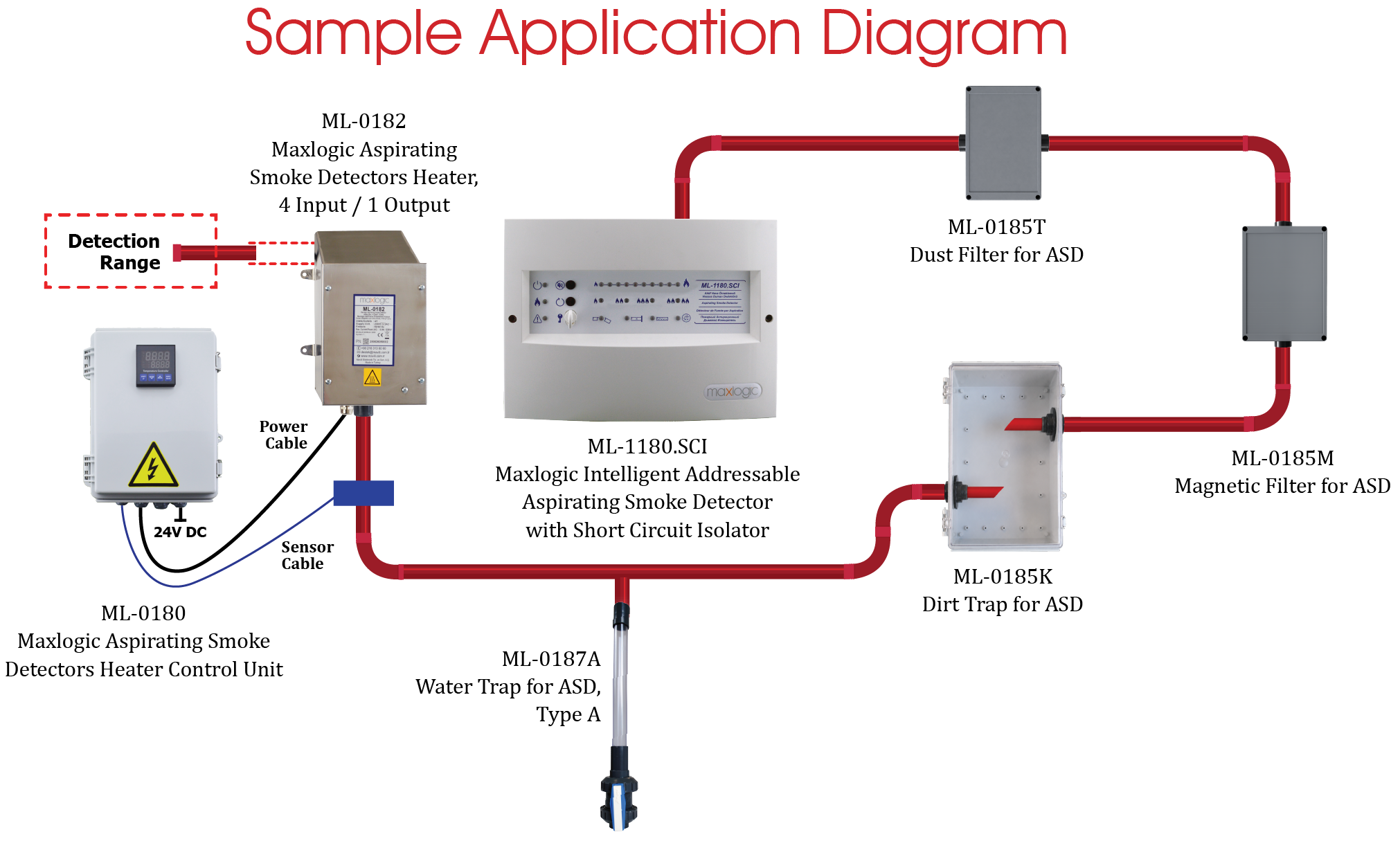
The ML-0185K Dirt Filter can be used as a pre-filter to limit the transfer of coarse dust, dirt, fibres, insects and similar large particles to subsequent sections of the pipe system. The system can be configured together with the ML-0185T Dust Filter to retain finer particles that continue to circulate.
The ML-0185H5 and ML-0185H10 Heavy-Duty Dust Filters, developed for more demanding operating conditions, are intended for applications with high dust loads, including cement, gypsum, mining, quarrying, metalworking, foundry, recycling, textile and dust-collection facilities. Their washable and reusable design supports operational continuity in industrial facilities where regular maintenance is performed.
The purpose of filtration is not limited to reducing the possibility of unwanted alarms. Limiting the contamination load to which smoke detecting elements, airflow sensors and fans are exposed, thereby supporting the service life and stable operation of the system, is also an important aspect of filtration design.
Separation of Metallic Dust
In metalworking facilities, a significant proportion of airborne particles may consist of metallic material. These particles may be drawn into the sampling pipes in areas where CNC machining, turning, milling, grinding, welding, cutting, casting and rolling processes are performed.
The ML-0185M Magnetic Filter has been developed to retain metallic dust using powerful neodymium magnets. Its ability to operate without creating significant resistance to airflow helps maintain the air and pressure balance within the sampling system.
Using the ML-0185T Dust Filter to retain fine dust that may continue to circulate after the magnetic filter creates a more comprehensive filtration arrangement in which different particle types are separated in stages.
This solution helps protect the detection system in applications such as metalworking workshops, welding and cutting areas, foundries, rolling mills, automotive manufacturing facilities and metal-recycling areas.
Managing Humidity and Condensation Risks
Facilities with high humidity levels and applications exposed to significant temperature differences require a dedicated design approach for aspirating systems.
Air drawn from a cold area into a warmer location, or humid air exposed to temperature changes within the pipework, may result in condensation. Water reaching the detection chamber may affect system performance, maintenance requirements and alarm stability.
Condensation trap filters used to reduce this risk help separate condensation that may form within the sampling pipes before it reaches the detection unit. Water accumulated inside the filter can be drained during maintenance.
Type A and Type B condensation trap filters are designed for use in cold-storage facilities, refrigerated rooms and HVAC applications where humidity is high but the dust load is relatively low.
Type C5 and Type C10 models are developed for more demanding environments where humidity is accompanied by dust, oil particles or other contaminants. These include industrial kitchens, paper and textile production areas, greenhouses, humid tunnels, metro systems and other underground facilities.
This approach ensures that system design considers not only the removal of water but also the different contaminants present within the environment.
Controlled air aonditioning at low temperatures
In frozen-food warehouses, cold-chain logistics centres and industrial areas operating at low temperatures, transporting sampled air directly to the detector may increase the risk of condensation.
Heaters developed for these applications raise the temperature of cold air to an appropriate operating level before it reaches the detector. However, applying uncontrolled heating alone may cause sudden fluctuations in air temperature.
The ML-0180 Heater Control Unit regulates the heating process and enables cold air drawn from the environment to be heated to a standard level of 5°C. Where required, the system can be adjusted to 10°C, helps maintaining the defined temperature at a stable level.
This arrangement is intended to reduce the risk of condensation forming within the sampling pipes and on the surfaces of the smoke-sensing elements, while supporting reliable detector operation within the specified temperature tolerances.
Heater models with 2 inlet/1 outlet, 4 inlet/1 outlet and 4 inlet/2 outlet configurations are available to accommodate different pipework designs.
Pipework Design as Part of Detection Performance
The performance of an aspirating system is not determined solely by detector sensitivity. Pipe length, the number and diameter of sampling holes, fan speed, end-cap configuration and pipe topology also influence air flow rate and sampling balance.
The Maxlogic system can operate with single-pipe, U-type and 2U-type pipework configurations.
In single-pipe systems, the sampling pipe can be configured with a length of less than 150 metres and a maximum of 60 sampling holes.
In U-type systems, the total pipe length can be designed to remain below 250 metres, with each individual pipe branch measuring less than 125 metres. A maximum total of 60 sampling holes can be distributed across the two pipes.
In 2U-type systems, the total pipe length can be configured to remain below 400 metres, with each individual pipe branch measuring less than 100 metres. A maximum total of 60 sampling holes can be distributed across the four pipes.
In all these configurations, the distribution and diameter of the sampling holes, the length of each pipe branch, end-cap arrangements and the required airflow must be evaluated together.
This flexibility enables different pipe routes to be created not only for regularly arranged spaces such as data centres, but also for high-ceiling buildings, large warehouses, aircraft hangars, energy facilities, ventilation ducts and areas that are difficult to access.
An Adaptable Solution for Different Applications
Aspirating smoke detection systems can provide significant advantages, particularly in buildings where conventional detection methods are limited in terms of application or accessibility.
The principal application areas for the Maxlogic system include:
- Data centres and information technologies centers
- Telecommunications centres
- Aircraft hangars
- Ammunition storage facilities
- Valuable document archives
- Museums and art galleries
- Historic buildings and artifacts
- Laboratories
- Cleanrooms and precision-manufacturing areas
- Intensive care units
- Warehouses and cold-storage facilities
- Petrochemical facilities
- Transformer buildings
- Ventilation ducts
- High-ceiling or difficult-to-access structures
- Dusty, contaminated or high-humidity industrial environments
Each of these applications has a different risk profile. Detector sensitivity, sampling pipework and auxiliary equipment must therefore be selected according to the project-specific environmental conditions.
The Right System with the Right Environmental Configuration
High sensitivity is an important performance criterion in early smoke detection technologies. In an actual facility, however, reliability can be achieved by considering sensitivity, airflow, pipework design, filtration, temperature control and maintenance together.
Rather than applying the same detector configuration to every environment, the actual environmental risks within the facility must be analysed. It should be determined whether the environment contains coarse debris, fine dust, metallic particles, water droplets, high humidity or a risk of condensation, and the filtration and sample-air conditioning arrangement should be configured accordingly.
The maintenance plan is also an integral part of system design. Cleaning or replacing filters, draining liquid accumulated in condensation traps, inspecting sampling pipes and monitoring airflow values help maintain detection performance.
With its range of filters, condensation traps, heaters, control units, detector models and pipework options, the Maxlogic High-Sensitivity Aspirating Smoke Detection System provides an integrated solution designed not only to detect smoke at an early stage, but also to maintain detection performance under different environmental conditions.
Because success in high-sensitivity fire detection depends not only on how early smoke is detected, but also on how effectively the detection system is adapted to its operating environment.
For more information please visit: https://mavili.com.tr/en/
About the Author

Mavili Elektronik Global
Mavili Elektronik A.S. has been GENERATING CONFIDENCE since 1987 with Mavili, Mavigard, Maxlogic, Maxlogic & Mavigard brand names. Mavili manufactures fire and gas detection systems which have CE certificates from notified bodies like LPCB. Mavili products are exported to more than 60 countries in different regions of the world, in addition we always provide pre-sales and after sales support for our CUSTOMERS AND DISTRIBUTORS. Mavili continues manufacturing high quality products and maintaining services with its dynamic staff of more than 250 people, composed of technicians and engineers, working hard for CUSTOMER SATISFACTION.
