At approximately 01:17 (UTC) / 04:17hrs local time, on Monday, 6 February 2023 a massive 7.8 magnitude earthquake hit southern Turkey and northern Syria, shortly followed by a second 7.7 magnitude quake. This was the largest earthquake to hit the region in 100 years. The earthquake affected over 14 million people, and over 350,000km2 of the country suffered damage from the shockwaves.
Recognising that this was an unprecedented event, the Turkish Government requested assistance in responding to the earthquake, via the United Nations International Search and Rescue Advisory Group (INSARAG). They notified teams via the Global Disaster Alert and Coordination System (GDACS) where teams had been monitoring the earthquake events. More than 140,000 rescue workers from over 90 countries around the world responded to assist with the rescue operations, which presented its own challenges of which more later in the article.
With such large-scale disaster one of the issues an affected county faces is how to organise the rescue response and deal with the sudden influx of rescue workers, equipment, search dogs and aid suddenly travelling to and arriving in the country at short notice. Part of the requirements to become a INSARAG Classified Urban Search and Rescue (USAR) team is to help provide coordination if there is a need, setting up and running a Reception and Departure Centre (RDC) at entry ports into the county where teams are likely to arrive, until such time as UN Disaster Assessment and Coordination (UNDAC) staff arrive to take over.
The role of the RDC is to assist the local authorities with the arrival of the incoming teams and help facilitate and ease the entry of the teams into the country with things such as customs, immigration, local transport and up-to-date information about the latest developments of the disaster. In this case, a large number of the international teams had indicated on the GDACs Virtual on Site Operations Coordination Centre (Virtual OSOCC) that they would be entering the country via commercial or chartered flights, arriving at Adana Airport.
Staffing of RDC
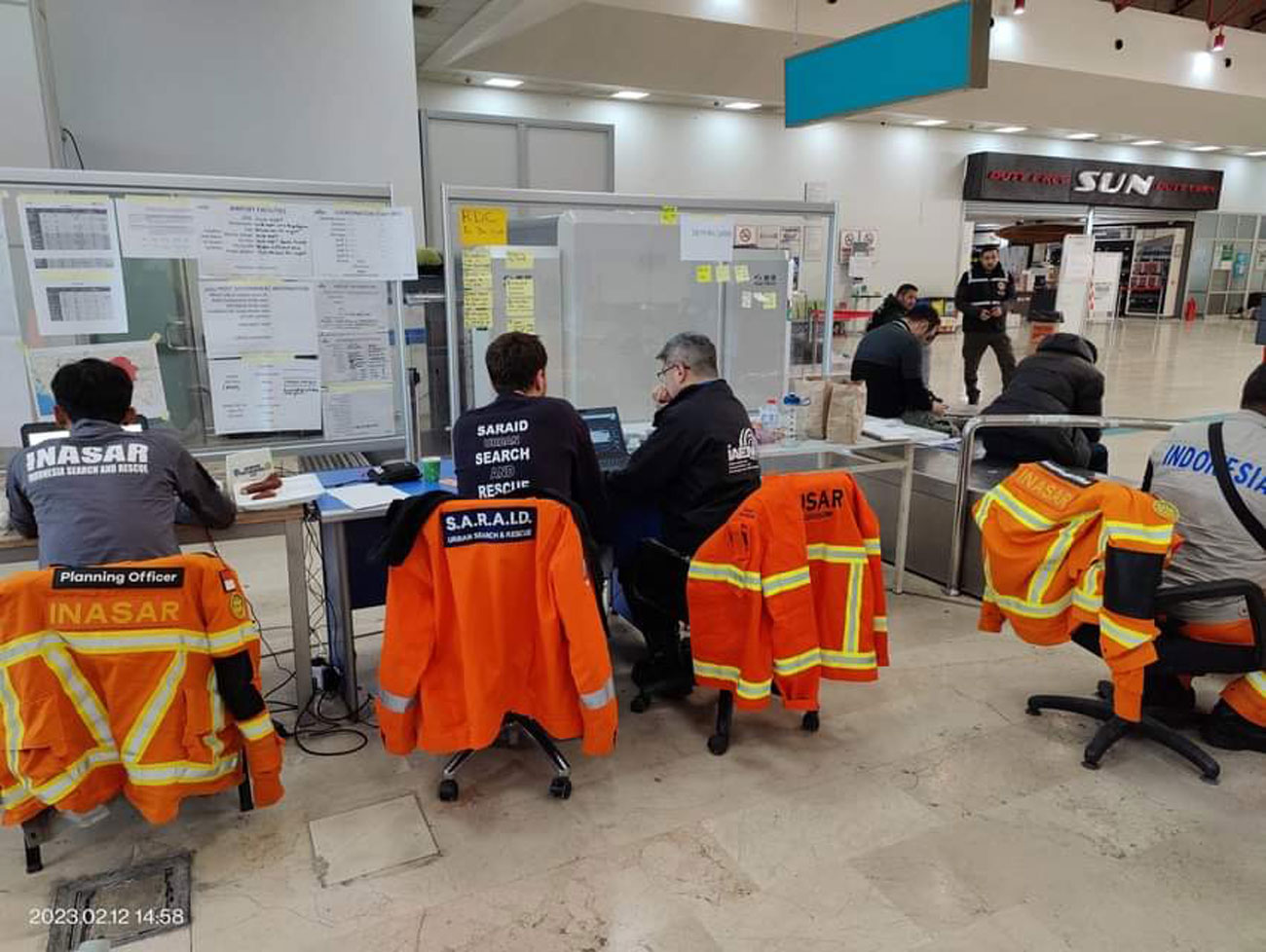
The national Swiss Rescue Team happened to be in Turkey for a training exercise with AFAD (Turkish Government Disaster Management Agency) when the earthquake occurred and realising that there would be this influx of teams arriving, they travelled to Adana Airport to set up the RDC in the arrival’s hall of the airport, at the customs and immigration area. The Swiss rescue team operated the RDC in the first 24 hours. Subsequently the German NGO @Fire (7–10 Feb), UK NGO SARAID (10–12 Feb), international NGO IAEM (12–16 Feb) and national Indonesian rescue team (13–17 Feb) arrived respectively and operated the RDC.

Workflow of RDC (Incoming)
An arriving team was assigned an area of the arrival hall to wait while the team leader and deputy team leader registered the team with the RDC (at the same time receiving a situational update from the RDC staff) and were provided with relevant contact details and information, before being taken to meet with AFAD who assigned the team to a sector where assistance was needed. Once each team was assigned to a sector, they returned to the RDC area to be notified which sector they were working in and collected the remainder of their team to depart to the sector in transport arranged for them by AFAD.
The RDC would then update a primary spreadsheet which was accessible by the local USAR coordination Centre in each sector, so they knew which teams they had available to them to assign to rescues.
Workflow of RDC (Demobilization)
When the USAR team made the decision to be demobilized, they would inform their SCC and submit INSARAG forms to the UCC and RDC. Based on the need, the RDC assisted to inform the airport and AFAD make further arrangements, such as animal health certificates, cargo services and transportation. The RDC also updated the estimated time of departure of the team so that the UCC could make informed decisions.

Lesson learned
- Under the current practice, the USAR teams should leave a designated number of trained members to operate the RDC and UCC. Considering the teams also need trained members for coordination in the field, a specialist/dedicated coordination team (similar as UNDAC) should be established for managing the RDC and UCC. These coordinators could be specifically trained for the role and could use the experience they gain for each deployment to constantly improve the process.
- All USAR teams shall be registered in the RDC for further sector assignment. Before arrival, the classified USAR teams could submit the team factsheet through the Virtual OSOCC. It is suggested that all incoming teams complete the registration before they leave their country. Then the RDC and UCC both could carry out the coordination work, such as assigning the team ID for non-classified team and the worksite/sector. As a result, these teams do not have to wait at the RDC.
- Communication by cell phone network and internet was restricted by the minimal equipment the teams brought with them. Having dedicated coordination teams with specific RDC/UCC communication hubs that could transmit their own Wi-Fi network would improve comms for everyone.
- Familiarity with the USAR Coordination Mechanician and INSARAG Guidelines are critical. As airport settings and local emergency management practices are not the same across the world, using the same methodology in different environments flexibly is critical.
- Strong networking helps the USAR teams to work together closely and effectively. In the Turkey operations, the SARAID and @Fire are similar NGOs and at the time of writing are two of only four Classified International Light Teams in the UN system. As such we train together regularly, so can easily interact and work together as one team.
- The RDC is required to handle the registrations for incoming and demobilizing and report to the UCC. A standard report form makes the data exchange more effective.
Conclusion
Overall, the RDC would not work well without the support of different stakeholders, such as international USAR teams, INSARAG, AFAD, customs, airport authority and European Union Civil Protection, etc. However, the preparedness work needs to be continued and enhanced because we never know when the next disaster will come. It is also the reason that the INSARAG organizes the regional earthquake response exercise every year and reviews the INSARAG Guidelines regularly.
About the Author

Chris Hurley
Chris Hurley is a USAR technician and International Response Team Leader with SARAID. http://www.hurleys.org

Mr Bruce Wong is Country Representative of the International Association of Emergency Managers and USAR instructor of the International Technical Rescue Association.