According to the NFPA (National Fire Protection Association), in the United States, the average yearly number of structure fires in high-rise buildings is 14,500. In the United Kingdom, which has significantly fewer high-rise buildings, the number is 772. Between 1993 and 2019, there was a total of 3.1 million reported fires around the world with 19,200 recorded fire deaths.1
From all these fire deaths 84.6% occur in residential buildings.2
‘High-Rise Horror’3 and ‘Tragic. Horrific. Avoidable.’4 These headlines refer to the Grenfell Tower tragedy. On 14 June 2017, a fast-spreading fire in the 24-storey residential block claimed 72 lives in London.
‘All 17 victims of Bronx apartment fire, including a 2-year-old, died of smoke inhalation’5 On 9 January 2022, an electric heater sparked a fire which filled a 19-storey apartment building with smoke in New York City. Especially tragic, eight of the victims were children.
‘At least 10 people dead in Valencia high-rise fire’6 On 23 February 2024, a fire fuelled by high winds and cladding consumed the 14-storey high-rise with 138 apartments in Valencia, Spain. The fire claimed the lives of 10 residents.
‘15 dead, 44 injured in residential building fire in Nanjing, China’7 On the same day as the Valencia Fire, a blaze broke out amongst electric bikes being charged on the first floor of an apartment block in Nanjing City, China. The fire left 15 dead and 44 more injured.
What makes the fire so deadly? Beyond the flames, it is the smoke that poses a serious threat. According to the NFPA, smoke inhalation is one of the most prevalent causes of death in building fires. Most fire victims inhaled carbon monoxide, smoke and other gases. In a fire, thick smoke disorientates the victims and the carbon monoxide, which is being given off by the fire, begins to replace oxygen in the bloodstream. Carbon monoxide (CO) is also known as the silent killer because it has no warning properties, it is both odourless and tasteless. Due to the lack of warning properties, unless there are CO detectors present, CO will remain undetected. Not only is it silent but it is also deadly in small amounts. Additionally, the burning of synthetic substances, (PVC flooring and pipes, furniture and mattresses) release additional toxic gases, adding to the list of toxins consuming the building. All these gases are literally smothering those stuck inside a building during a fire.
According to a study from 2018 titled ‘Fire Safety Issues in the Design and Construction of High-Rise Buildings’ the top two fire safety issues in high-rise buildings are the construction of the building and the evacuation of people. This article will focus on the evacuation of people and present a simple tool which can be used to help evacuate safely from such fire situations.

What to do, when trapped in a building and smoke and gases begin to flood the hallways and stairwells? This is where a fire escape hood can be an extremely helpful tool.
What is a fire escape hood? A fire escape hood, often referred to as a smoke hood, covers the head of the user while a filter placed in front of the mouth a nose connects to the outside atmosphere and filters out toxic fire gases and particles, giving the user clean air to breathe. Smoke hoods protect victims of fire from the effects of smoke inhalation. The filter itself is the heart of the unit. Unlike standard gas filters, which often use activated carbon as a filter material, a fire escape filter, which protects against CO, uses the filter material hopcalite. Hopcalite is a catalyst which removes CO from the air by oxidizing it into CO2. A smoke hood gives users a minimum of 15 minutes of escape time, whilst protecting them from the carbon monoxide and other fire-related gases.
At the scene of a fire, it is usually the fire services who are first on site and coordinate rescue activities. For fire services in Germany, it is mandatory for all extinguishing vehicles, depending on their size, to have two to four fire escape hoods on board. These units are immediately available at any incident and are used to rescue victims. Many firefighters always carry an escape hood with them, attached directly to their breathing apparatus. This can be used for unexpected victim rescue or in a severe emergency for self-rescue.
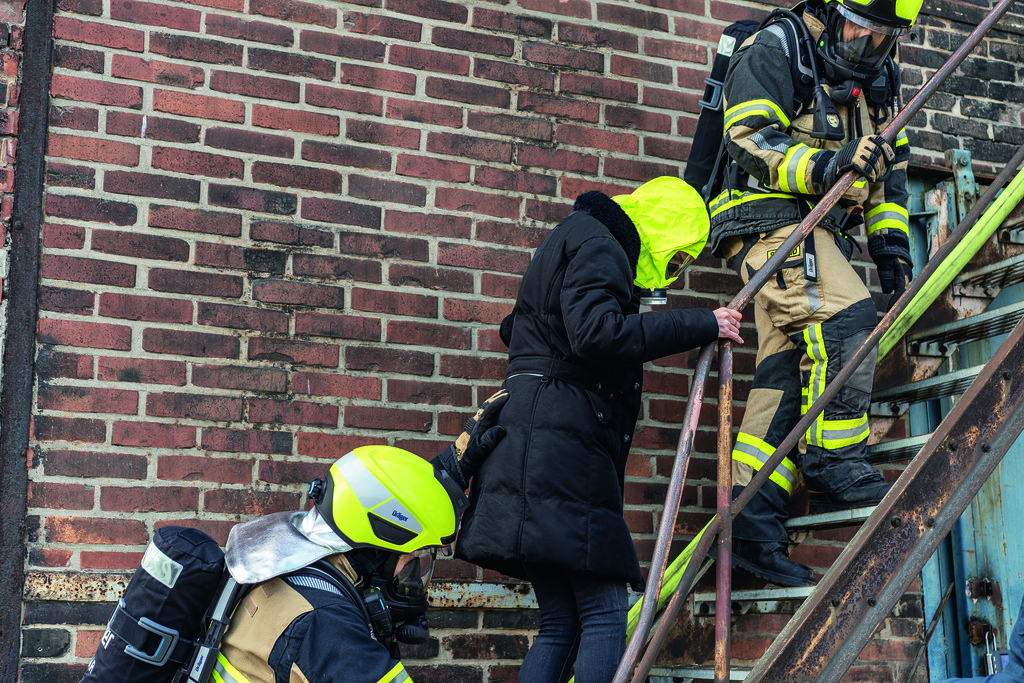
What does an application scenario look like with a fire escape hood? A typical setting is a building fire, for example an apartment complex where there is a fire in the basement. The stairwell and hallways, which are the main evacuation routes, have filled with smoke and other fire-related gases. In this case, the firefighters equipped and using breathing apparatus go to the apartments with residents. The residents are given a brief introduction to what the fire escape hood does and how to wear it. They will then be equipped with the fire escape hoods and led by the firefighters through the stairwell and out of the building. The use of the fire escape hood will allow them to breathe safely while evacuating.
In a few other European countries, including Austria, Netherlands, Switzerland and Malta there are similar regulations, and the fire brigades actively carry and use fire escape hoods for victim rescue. In London, the provision of smoke hoods was one of the key recommendations within the Grenfell Tower Inquiry Phase 1 Report. As a result, in 2018 the London Fire Brigade implemented the use of fire escape hoods for victim rescue. Thereafter all other brigades in the United Kingdom followed suit and are also successfully using fire escape hoods to rescue victims. The South Yorkshire fire service’s first experiences with the hoods led them to the conclusion that the hoods provide firefighters with vital extra time to consider their priorities and plan the safest exit route as opposed to simply getting people out as quickly as possible.8
Unfortunately, this type of best practice is still limited to the few European countries mentioned and cannot be found in brigades all over the world. However, gradually additional fire brigades are seeing the benefits of using fire escape hoods to rescue victims and are adopting this practice locally despite the lack of national mandates. Fire is global and knows no boundaries. In Austria, National law mandates that all hospitals and care homes have a minimum of 40 fire escape hoods on hand. Because when the extinguishing truck arrives with four hoods, this likely won’t be enough to evacuate a hallway full of patients in a hospital. A lack of regulations has not stopped individual persons from using fire escape hoods. Many private people who travel regularly (e.g. pilots), persons regularly driving through tunnel systems and residents of high-rises are just some examples of individuals who use fire escape hoods on a regular basis.

Factors to consider when evaluating the use of fire escape hoods:
1. The ease of use. In an escape situation where users may already be disorientated from thick smoke, it is essential that the use of a fire escape hood is self-explanatory and quick. No time should be wasted on trying to open or don a device.
2. Type of filter for hazards. There are different filter types available for different risks. What are the risks at hand? Does the filter need to protect primarily against CO, fire-related gases and particles or is additional protection against hazardous industrial chemicals needed? In such cases a combined Fire & Industrial Escape hood may be the best option.
3. Approvals and certification. To ensure that the device will provide the protection it claims to, make sure to take a close look at the approvals and certification. The EN 403:2004 is the leading standard for fire escape hoods. It tests and validates protection against fire related gases, like carbon monoxide from 2,500 to 10,000 ppm for at least 15 minutes. Products may claim longer durations, but these durations are not a part of other standards. Products without a valid certification to a valid standard do not have guaranteed or audited performance. This is critical in ensuring the integrity of a product. After all, the devices are only used in emergencies, and it should be certain that they will do what they promise when the need arises.
4. Protection for unused filters and hoods. In most cases, a fire escape hood will not need to be used but in case it is needed it must be in a useable and acceptable condition. As a hood may have been on the wall or in storage for years before use – it is critical that the hood and its most vital element, the filter, are well protected by their packaging. Additional features like security tags can identify tampering and ensure the hood remains in factory-packed condition.
5. Service Lifetime. As with any type of device, it is recommended to see what kind and at what intervals service is needed. This determines the overall cost of ownership.
6. Packaging, carrying and storage options. The available options and application at hand need to be analysed. Should the device have a wall holder to be placed in strategic locations or is a device with a shoulder strap to carry along better suited for the escape application? These factors may seem minor but should be considered when choosing a fire escape hood.
Fire escape hoods are a simple, easy and effective tool to have available for emergency situations. For years, they have helped people safely escape from fires. Just look in a German newspaper reporting about a local fire, and you will see victims being rescued with escape hoods. Unfortunately, often a tragedy must occur for procedures to be changed and the use of smoke hoods adopted. As we have all likely experienced, even the best measures can fail and, in such cases, it is wise to prepare for the unexpected. When every second counts, consider the use of a fire escape hood.
For more information, go to www.draeger.com/en_uk/Products/PARAT-Escape-Hoods and www.draeger.com/en_uk/Products/PARAT-5550
References
- CTIF (International Association of Fire and Rescue Services) World Fire Statistics, 2021.
- CTIF (International Association of Fire and Rescue Services) Report detailing World Fire Statistics from 2023
- Daily Express, Thursday June 15th, 2017
- The i Paper, Thursday June 15th, 2017
- CNN, November 1st, 2022
- Euronews, February 23rd, 2024
- South China Morning Post, February 24th, 2024
- The Star, June 24th, 2021
About the Author

Suzanne Johnson
Suzanne Johnson is the global product manager for escape hoods at Dräger Safety. She has over 20 years of experience in product management, the last 16 of those with escape hoods. Suzanne earned an MBA from the Nordakademie and holds a bachelor’s degree in international management from Hamline University. Suzanne is from Minneapolis, Minnesota and resides in Germany.