

In the 21st century and in the midst of a technological revolution, when science can develop vaccines in less than a year, I am concerned about the impact that the imbalance, saturation or collapse of an essential service or critical infrastructure may have. Now more than ever before, we can understand how catastrophic this can be.
There is an obvious need to plan better and provide these facilities and services with regulations and standards that address the need to ensure service continuity and prevent any issues from impacting other critical or essential infrastructures or services.
Fire safety legislation and the related standards are aimed at meeting the basic requirement of protecting people’s lives. In my opinion, this should be a mandatory minimum requirement that is widely implemented. However, in the case of critical infrastructures and/or essential services, this requirement should be far more stringent since, as a matter of necessity, the continuity of operations must be ensured by adopting systems that enable any incident to be identified very quickly, as well as being easy to use and offering extensive connectivity options.

Without question, the regulations and related standards need to evolve to meet the requirements necessary to protect property and the continuity of operations.
Using fire detection and alarm systems that provide several warning levels will allow staff to have the opportunity to investigate and act swiftly, long before any control and extinguishing processes begin, with the aim of preventing any damage that they may cause. In this regard, using aspirating detection equipment with numerous alarm levels makes it possible to create a more effective action plan, preventing the fire from spreading.
So, a system that provides up to five alert signals would enable manual verification and control at its first alarm level. At the second alarm level, authorisation would be given to manually shutdown the ventilation or call the emergency response team. At the third alarm level, the system may trigger the automatic shutdown of ventilation or the evacuation of the affected area. At the following two alarm levels, extinguishing, alarm and general evacuation processes can be sequenced.

The use of visual incident management systems will allow the incident and emergency level to be identified quickly. It is very useful to have control systems that are intuitive – remember that not everyone with access to them is knowledgeable in this area – systems that allow you to quickly assess the status of the protection plan and take direct action regarding the related manoeuvres.
Using conventional systems is unthinkable for these types of facilities. Only addressable systems that provide accurate information about the location of the incident and valuable information for users, the person responsible for the infrastructure’s safety and the emergency services are suitable.
The architecture of detection systems in this type of infrastructure can be complex and their Achilles’ heel lies in the strategy used to report high-density data, especially in the event of an emergency. It is vital to get this right with a robust system that reports any incident and the completion of the established action plans in very few seconds.

Similarly, as architectures are becoming increasingly complex, there is a growing need to incorporate more sophisticated manoeuvre control methods, requiring a high number of interactions and operating conditions. These may be affected by the type of alert trigger, the condition that it adopts, the preliminary conditions, the environmental conditions, the operating plans and rosters, the evacuation plan and any other factor.
VESTA is an addressable alarm and detection system with the most advanced configuration and functional features available on the market. The VESTA addressable control panel is designed to work with Detnov’s whole range of addressable devices. Its modular design provides the user with an extremely powerful and completely flexible system. It supports up to 32 loop control panels and the network can consist of up to 64 nodes. VESTA offers scalability that is currently rarely found, with the ability to control a total of 512,000 devices.
A detailed visual hierarchy can be displayed on the fire control panel, making it possible not only to show the precise geographical location and the alarm levels reached but also to visually recognise the sequence of preset actions in the manoeuvre rules. These are recognised as virtual relays which, in turn, can be activated as button functions on the control panel. The control panel can control up to 1,000 virtual relays.
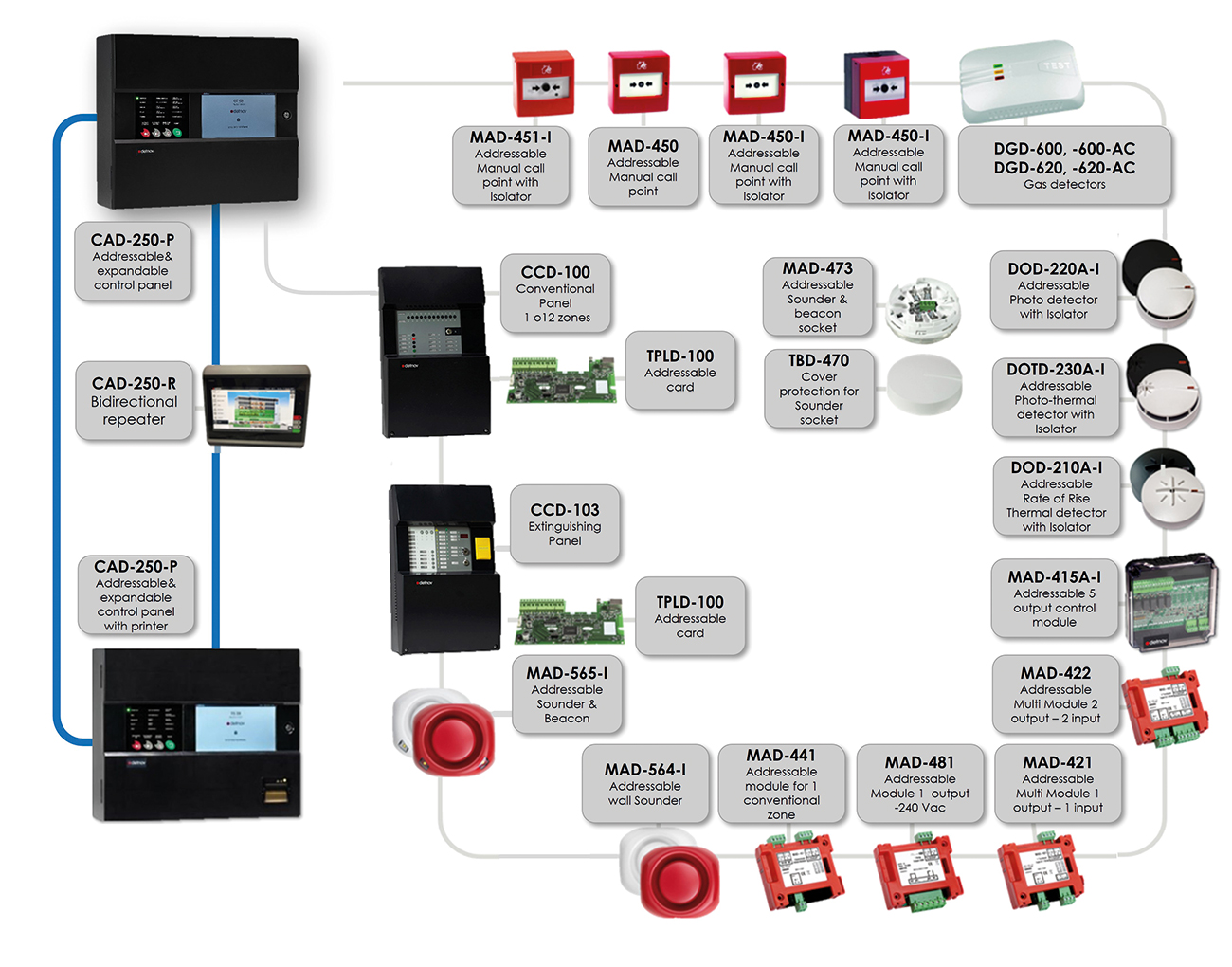
VESTA’s versatility is thanks to its state-of-the-art processor, allowing us to meet the most complex infrastructure needs. VESTA divides the areas into three levels, 250 areas, 2,000 zones and/or 1,000 action groups. It is possible to create up to 100,000 actions or manoeuvre events and 2,500 special modes. Special modes can be configured to allow you to create specific plans by time, day or month.
Thanks to the different communication cards, the VESTA system can be fully integrated with Alarm Receiving Centres (ARC) and Building Management Systems (BMS) or meet any other needs that the customer may have.
VESTA has a 10in high-resolution TFT COLOUR screen (1024 x 600 pixels). Its simple interface with intuitive messages and graphic management of interactive floor plans and maps allows the source that triggers the fire alarm to be located in a matter of seconds, meaning that incidents can be handled in less time than with standard screens available on the market.
It also allows you to create control panels to monitor and manage the emergency from the facility’s various fire-protection systems.
At a glance, the control panel allows maintenance staff to take any appropriate steps for the facility: dirty detectors, disabled components or any problems affecting the devices, thus reducing contract maintenance service times.
For more information, go to www.detnov.com
