
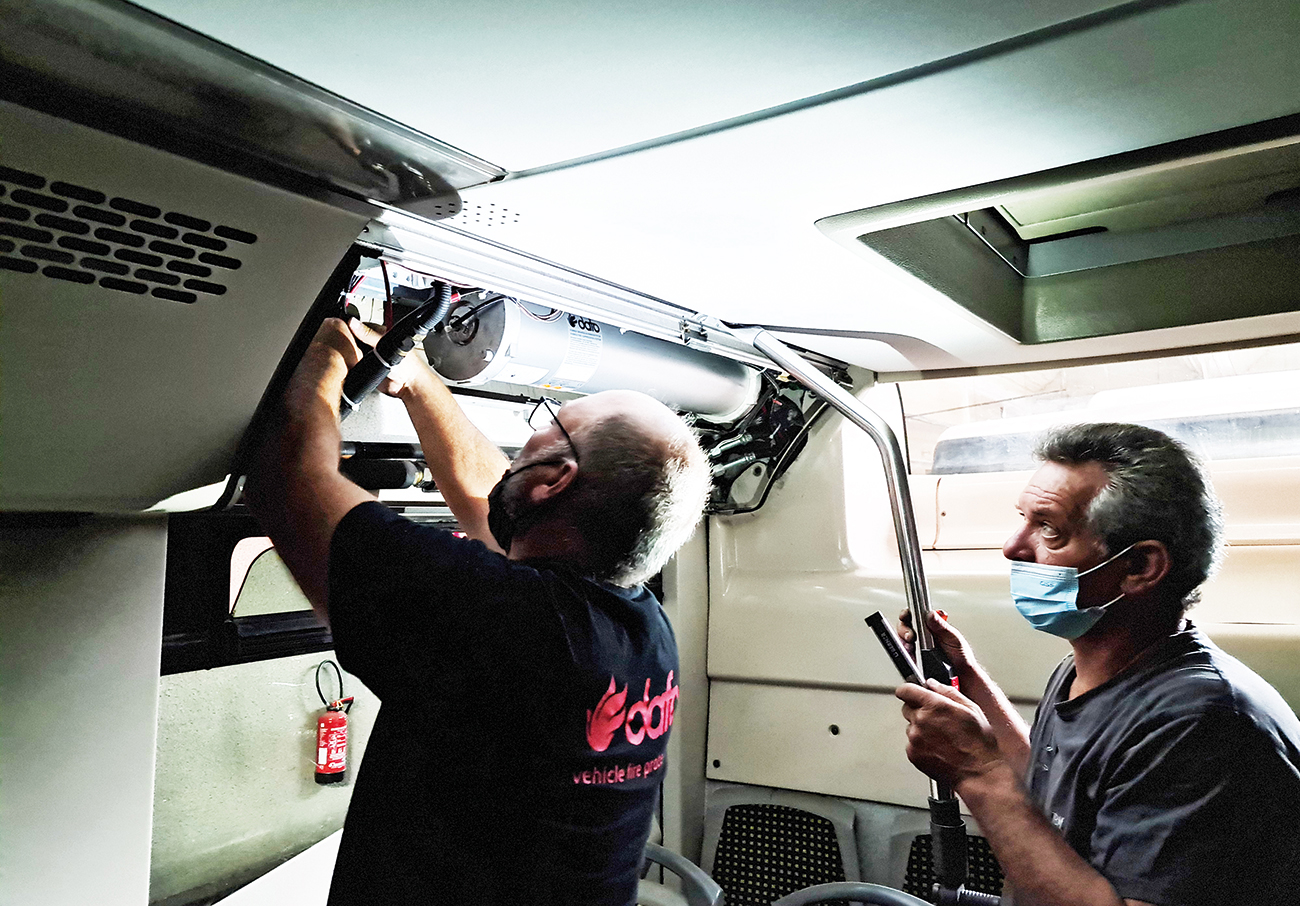
As countries around the world pledge to reach climate-change targets, and net-zero emissions being a large part of this, the world is seeing a massive transition to renewable fuel sources. Therefore, the automotive industry is changing to meet the growing demand for electric and hybrid public transport.
Jonas Bergström, business manager, Dafo Vehicle Fire Protection – bus and coach division, explores vehicle fire risks as the bus industry moves toward electrification and discusses how vehicle operators can reduce risks.
Changes in European regulations
The United Nations Economic Commission (UNECE) has enacted Regulation 107 to make combustion engine buses and coaches safer, making it mandatory for these vehicles to install an automated fire-suppression system within the engine compartment.
However, this regulation doesn’t address fire hazards that occur in electric vehicles (EVs). For hybrid electric vehicles (HEVs), their combustion engine will be covered by the UNECE’s regulation, but, as batteries for these vehicles use lithium-ion (Li-ion) batteries, traditional fire suppression might not be up to the task of protecting HEV vehicles completely.
UNECE Regulation 100 (Construction and Safety of Electric Powertrains) published its latest draft, which outlined a proposal recommending an early warning system in the event of battery failure or damage that might cause a fire. It states that if there’s a risk of thermal runaway, the vehicle’s detection system should provide early warnings. Therefore, to spot battery failure at the earliest possible stage to prevent ignition, fire-suppression systems need to recognise when thermal runaway might take place and how to prevent it.
New fire risks and how to identify them
Li-ion batteries, which often power EVs and HEVs, are at risk of experiencing thermal runaway. This can occur following a defect in the battery’s cells – caused by overcharging, overvoltage, overheating or physical damage – which leads to rapid temperature increases that can cause fire, toxic gas emissions and potential explosions. This is increasing risk to life and vehicles, as traditional systems can often be inadequate in extinguishing thermal runaway.
Research has found that one of the most effective ways to extinguish these types of fire is by using huge amounts of water for an extended period; however, this suppression method is often not practical, as buses may need to be moved to be stored elsewhere quickly to reduce risks. Therefore, to avoid this method, an early fire-warning system and spot cooling is the most effective method to prevent thermal runaway while localising and suppressing a fire.
As a result of EVs and HEVs being introduced in the public transport industry, there are various new challenges to overcome and risk assessments to put in place. For example, the location of fire risks is different in traditional combustion-engine vehicles and EVs. Often, combustion vehicles are at risk within the engine compartment, when we move to electric, additional protection zones will need to be protected.
The Research Institutes of Sweden (RISE) issued an assessment for fire-risk management, which can be used as a guideline:
1. Hazard identification
2. Risk estimation
3. Risk evaluation
4. Risk reduction.
This should include failure mode and effective analysis (FMEA) to identify hazards and then quantify risks, so they can be ranked according to their priority. After risks have been quantified, they’re able to be listed to provide a holistic view in a risk map. This separates risks that are acceptable from those that need to be addressed.
Finally, an action plan for any fire risks identified will need to be finalised with adequate risk-reduction measures, including:
1. Risk elimination or minimisation by design
2. Active and passive protection systems
3. Improved cleaning or maintenance procedures
4. Improving the quality of training procedures.
Once hazards have been identified, priorities will naturally emerge as to which risks need to be addressed first.
For more information, go to www.dafo-vehicle.com
