
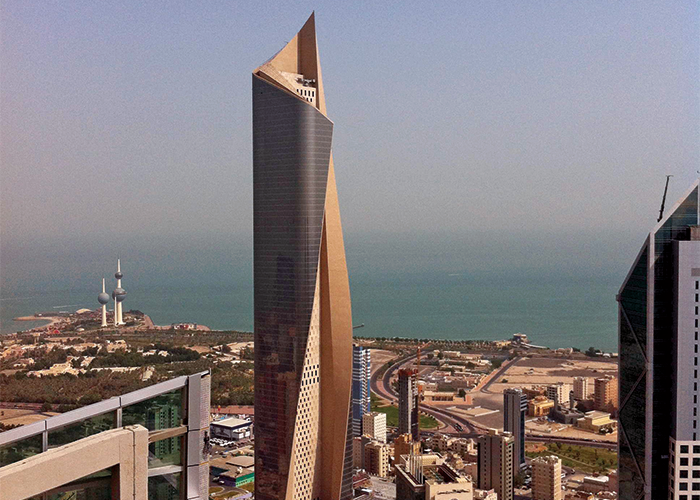
It is said it was the invention of the automatic elevator braking system by Elisha Otis that made the modern skyscraper a practical possibility and it is certainly hard to see how any building of more than six floors could be a practical possibility without elevators. In the mid 20th century centralised air conditioning became a practical proposition thus enhancing further the practicability of tall buildings – and, incidentally, making it possible to live and work in countries with very high ambient temperatures like the Arabian Gulf.
I would suggest that the third leg of the support mechanism of tall and supertall buildings is almost certainly the automatic fire sprinkler system as it’s impossible to think of modern high risk buildings being constructed without them.
Tall and Super Tall
It used to be an accepted truth in fire brigade practice that it was impossible to fight a fire in a building more than 30m tall from the outside. For many years this was the maximum height of a fire service ladder or hydraulic platform and as a result of this convention, most high rise (i.e. buildings more than 30m tall) have relied on internal fire fighting measures such as automatic sprinkler protection, fire compartmentation, ventilation systems, fire risers and hydrants and firefighting shafts and staircases.
Anyone who thinks that the problems of managing fire safety in very tall (over 200m) or super tall (ie over 400m high) buildings is a transient issue is sadly in error. A brief trawl of the internet in 2012 revealed that there were at least 30 buildings planned or under construction that will be taller than 400m – most notably the Kingdom Tower in Jeddah which will top out at 1000m – and taking the title from the 824m Burj Khalifa in Dubai in 2018.
Safety Problems on Super Tall Buildings
The causes of fires in super tall building construction does not differ from such issues in conventional buildings. What is different is the scale and extent of the problems of access, the number of persons at risk, water supplies and the skills needed in fire fighting. The value of the building and the business continuity impacts must also be considered.
Other factors which should be considered in respect of such buildings are:
- Exceptionally high costs of construction and fit-out often with very high standard of interior finishes
- Purpose-built systems such as elevators and external cladding
- Applicability of local building codes
- High prestige nature of such buildings and inevitably, the possibility that such will be terrorist trophy targets

Codes and Standards
While the GCC countries and other areas in the Middle East have all developed their own building codes it is fair to say that enforcement of these is often uneven and depends frequently on a small number of professional staff who may often be hard-pressed to cope with the volume of work which has inevitably followed the urbanization and intense development which is now the norm in many countries. One response to such issues has been to import overseas technical expertise or to ‘contract out’ code compliance assessments.1
One area of compliance checking is verification and validation of the extent to which fire protection systems have been installed and this can make additional demands on officials. To assist in this area, some jurisdictions have introduced a system of approving the designers/installers of protective systems – this to a great extent replicates the work of such UK bodies as the LPCB/BRE in third party certification work. Such certification schemes depend on the availability of consensus design standards as well as an empirical method of assessing the suitability of system components. These in turn need to be underpinned by reliable test houses
The availability of mature, well-accepted international design standards in respect of sprinklers is a key factor in their general acceptance expecially in life critical roles. Countries in the Middle East tend to follow one of the following standards:
- US – NFPA 13 – US – the most recent edition is 2016
- NFPA 13R and 13D cover respectively residential and domestic applications (also 2016)
- Europe: EN 12845 – the 2015 issue has just (October) been issued. Usually referenced in English as the UK version, BS EN 12845:2015
- BS 9251: 2014 – for residential and domestic sprinkler systems
In addition, within some national jurisdictions, approval will be given to sprinkler systems installed in compliance with international insurer FM Global’s data sheets. This carries on the tradition in both the US and European where insurers were originally responsible for writing sprinkler installation rules. This is still true of the UK LPC Rules for Automatic Sprinkler Systems which incorporate the full text of EN 12845 but sets out additional insurers’ requirements in certain areas. Where insurance policies are written in London or through Lloyds, compliance with the LPC Rules2 may be mandatory. These in fact provide significant additional information on innovative systems such as Extended Spray Fast Response Sprinkler systems (ESFR) which utilize wider bore pipe and larger sprinkler heads to apply greater amounts to water to fires at an early stage and are now frequently specified in warehouse protection where they can provide an alternative to in-rack systems.
Some Europe-based insurers may suggest compliance with CEA 4001:2013 Sprinkler Systems Planning and Installation which is also an insurance industry standard.
Types of Sprinkler System
Despite occasional suggestions to the contrary, all sprinkler systems are designed to protect life and property. However, where the presence of a fully operational sprinkler system is critical at all times – as for example in a large place of public assembly or an hotel – then additional measures may be specified to ensure that the sprinkler system is operational even when maintenance work is taking place.
Such ‘enhanced availability3’ systems may include duplicate pumps, tanks and valves and provide for the security and monitoring of valve sets. Obviously these features come at a cost so it is essential to ascertain at the specification stage whether such the client or the authority having jurisdiction believes these are essential.

Wet Sprinklers
Sprinkler systems where all the pipework which is water-filled at all times are most commonly type installed. They are found where there is no possibility of the water freezing and so are almost universal in the Middle East and Gulf.
Dry Pipe Systems
Dry pipe sprinkler installations are appropriate for applications either where there is a danger of the water in the pipes freezing. In a dry-pipe system the pipes on the ‘active’ side of the installation control valves are charged with air (or sometimes, nitrogen) which is under sufficient pressure to prevent the entry of water into the distribution pipework. Such systems may be found in large cold stores
Pre-Action Systems
A pre-action sprinkler system is a dry-pipe system linked to an automatic fire detection system which protects the same area. Operation starts when a heat or smoke detector in the protected area activates, (normally before a sprinkler head opens). At this point a ‘pre-action’ valve opens to allow water to flow into the sprinkler pipework before the first sprinkler head operates. Discharge of water will not occur until a sprinkler head operates. This type of system is quite often used in water-sensitive areas such as electrical equipment rooms, computer suites and for archive protection.
Deluge Systems
Deluge systems differ from sprinklers in that the discharge heads are open and all operate at the same time, triggered by a separate detection system. Deluge systems are used to protect against high hazard activities such as in flammable liquids.
Maintenance
The proper test and maintenance procedures undertaken by competent persons are important for all fire protection systems but are critical where fire suppression systems are integrated in the design of the building.
Summary
Automatic fire suppression systems are now recognised as a key contributor to the safety of all high rise buildings and it is doubtful if such structures could be erected without them. Even when not specified by local building codes, the presence of sprinklers will guarantee the safety of the building and its occupants should a fire occur.
For more information, go to www.risk-consultant.com
References
- This approach, for example is also followed in some parts of the UK where ‘Approved Inspectors’ exercise code supervision in place of municipal officials.
- Now published by the UK Fire Protection Association.
- See Annex F BS EN 12845:2015.
About the Author

Stewart Kidd MA, MSc, FIFireE, FIFSM, FSyI, FSA (Scot), CPP is a Chartered Security Professional. He has worked in security and fire protection since 1974 and now combines consultancy with expert witness assignments. He has a particular interest in the protection of national patrimony and built heritage, and he lectures and writes extensively on this subject. He is the author of eight books on fire and security topics including the Historic Environment Scotland’s Guide for Practitioners No 7, the Scottish Building Standards ACOP.
