
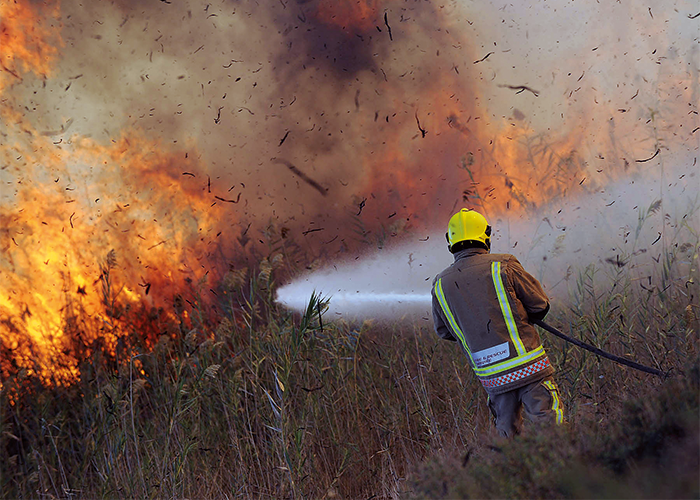
The last ten years has seen leading manufacturers, especially from the UK, focus increasingly on the relationship between firefighters and their PPE, and, in particular, the physiological impact of the protective clothing itself on the wearer. This approach also takes into account the ambient temperatures in which normal response operations take place.
Original wearer trials undertaken in the UK by Bristol Uniforms in 2003, in conjunction with Human Vertex at Birmingham University, provided empirical evidence, for the first time, of the heat stress impact of various different designs of firefighter garments under a range of typical activities. These included running, climbing and crawling. The results helped to identify the level of physiological impact of different layered constructions over different time periods of activity and led to the design of the first lighter-weight structural firefighter garments. The Ergotech™ and Ergotech Action™ designs became the style on which PPE was modelled until the introduction of the XFlex™ design in 2012. XFlex™ is a design platform allowing other products, such as the latest USAR garment, RescueFlex™, which meets EN ISO 11612, to have the same level of flexibility and overall wearer comfort. Most recently, LayerFlex™, introduced in 2014, is an innovative layered approach to meeting the different needs of technical rescue, structural and wildland firefighting using just three garments in different combinations. This offers inventory simplification and potential cost-savings. Other Bristol designed garments in their head-to-toe range include fire hoods and a range of firefighter gloves.
Across the world, firefighters are required to work in contrasting temperatures and weather conditions. In temperate climates, such as the UK, ambient conditions change markedly between summer and winter. In sharp contrast, Gulf States’ civil defence and industrial firefighters experience the constant heat of the tropical, and predominantly desert, climates which characterise most of the Middle East region. The advent of lighter weight PPE constructions, and most recently, the layered concept have contributed to the lowering of heat stress on firefighters. Today, UK designed PPE is protecting civil defence firefighters across the UAE, Kuwait, Qatar, Oman and Bahrain along with a growing number of other Gulf States. Oil producing Gulf States have also become regular users of British designed and manufactured firefighter protection at their oil and petrochemical installations.
In another area of industrial firefighting, transport, the Gulf States currently rely heavily on road transport to move industrial materials overland both within, and between, neighbouring states. Road transport is inefficient, costly and polluting and, where possible, avoided in favour of transporting liquids, especially oil, by pipeline to refineries or to ports for export. The oil-rich states want to improve their infrastructure by connecting their countries with railways to allow improved exports of petrochemical and non-oil goods.
Transport related fires frequently call on the skills of both firefighters and search and rescue teams whose specialist training and protection is focused on the different nature of these hazardous tasks. Given the typical characteristics of fires involving aircraft, trains and road vehicles where passengers are frequently involved, the priority is always to save lives. Close co-ordination between firefighters aiming to suppress flames, and search and rescue teams getting access to extricate the trapped and injured, is essential and a key part of training programmes.
Search and Rescue operations mostly take place once the immediate danger of flame is removed, with USAR or technical rescue teams entering enclosed and confined spaces where high temperatures and toxic smoke are major hazards and which may require suitable breathing apparatus as well as protective clothing. Essential characteristics of technical rescue clothing include tear and puncture resistance, protection against blood borne pathogens, physical protection at high risk points such as elbows and knees, a high level of flexibility in the garment to afford manoeuvrability in confined spaces and be as light as possible to minimise heat stress. Successfully protecting the search and rescue teams similarly depends on good training and the selection of the right personal protective equipment, especially clothing.

Firefighter PPE conforming to European Standard (EN469:2005) and US Standard (NFPA 1971:2013) are both used extensively throughout the Gulf by civil fire authorities and industrial users. This latest NFPA Standard includes minor changes from the previous version and has identified the use of impermeable reflective trim on fire coats as a potential cause of localised heat build-up. Bristol has offered breathable trim to address this issue for some years. This is just one example of the attention to minor, but significant health and safety related, aspects of PPE design which have characterised product developments in recent years and why the Company has continued to invest in technical developments which improve durability, reduce heat stress and enhance wearer comfort. Other examples include the use of new types of linings, such as Hainsworth® ECO-DRY Active and ECO-DRY Cool, which eliminate the need for a separate thermal barrier and the GORE® PARALLON™ System which combines a thermal and moisture barrier. Both offer improved wicking characteristics and breathability.
It is a measure of the UK’s reputation as a world leader in firefighter PPE design that so many Gulf States have come to rely on products designed and manufactured in Great Britain. Given the protective benefits of particular characteristics in firefighter clothing, which have been recognised through many years’ experience, it is not surprising that fire kit meeting the highest international protection standards are in demand throughout the Middle East. The latest designs have taken the flexibility of garments to a new level by introducing improved articulation at key points in the garments. This allows for greater manoeuvrability and comfort as well as ease of changing.
Ultimately, the effectiveness of firefighter PPE will depend on a number of factors which go beyond the protective qualities of individual pieces of clothing. In addition to selecting the right specification for the nature of the hazards to which the wearer will be exposed, attention must be paid to ensuring that the clothing is not only individually sized and made but that the head-to-toe PPE is fully integrated. Correct fit and kit compatibility are the keys to ensuring all round protection as is the correct maintenance of garments to ensure service life integrity. The technical fabrics from which today’s PPE is made have protective qualities which can only be fully maintained over time by careful management. This will require regular inspection for damage and soiling which needs careful repair, washing and decontamination. This should always be to the manufacturer’s specification. Given appropriate lifetime care and maintenance, the latest firefighter PPE is designed to provide increased service life over previous generations of protective clothing and the specification and selection of the right PPE should rightly be seen as an investment in the health and safety of the firefighter.
Called upon to handle an ever increasing variety of scenarios, linked to changing weather patterns, urban complexity and the vast range of materials used in construction in the 21st century, today’s firefighters are faced with a complex environment in which to operate.
These conditions are carefully studied by manufacturers of both clothing fabrics and designers of firefighter clothing. Together they have developed solutions to meet the changing needs of firefighters and, in particular, different types of protective garments to more specifically match the hazards of their operational environments.
For more information, go to www.bristoluniforms.com
About the Author

Roger Startin is Joint Managing Director of Bristol Uniforms and has been part of the Bristol team for over 30 years.
