
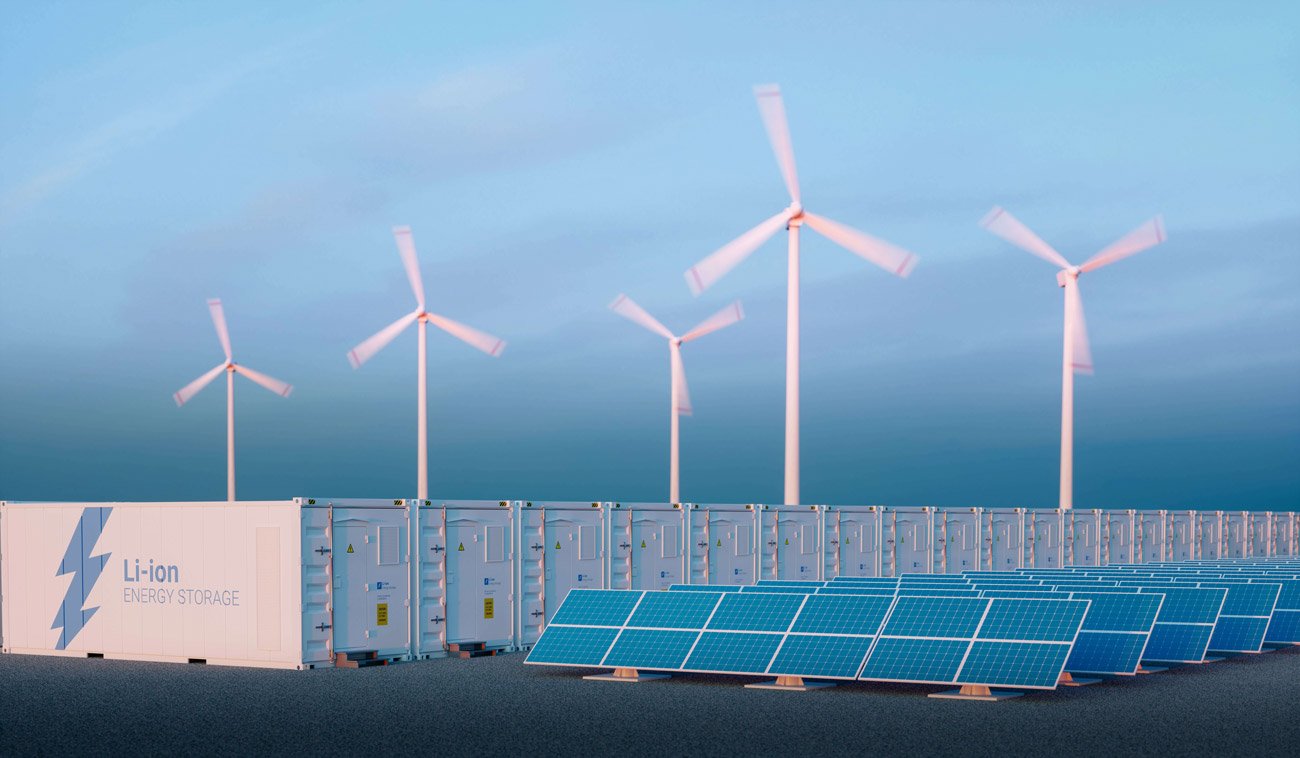
Stationary Energy Storage Systems (ESS) are available in numerous designs. Beginning with small units for individual purposes with only small capacities, there are likewise large ESS parks with capacities up to several MWh (see Figure 1).
Especially with respect to renewable energies, ESS are of high importance as they are used to store the energy generated at a given moment, e.g. by wind or sun, and make it usable when needed. Thus, ESS help to improve a power grid’s utilization, for example, by smoothing load peaks.
The most common battery type utilized in ESS is lithium-ion batteries. One reason for this is the increasing usage of second-life batteries often coming from the automobile sector.
By now, there are just very few regulations for ESS (for example [1]), particularly concerning fire protection.
Basics of battery technology
Like most batteries, lithium-ion batteries (LIB) consist of a cathode, anode and electrolyte (Figure 2). A semi-permeable layer electrically separates the cathode and anode (negative and positive poles). If this layer collapses or is damaged, an internal short circuit is generated, and the energy stored in the battery is released. Batteries combine highly flammable materials with high energy contents, which creates new hazards for the field of fire protection [2]. The risk of a battery’s ignition, due to internal or external reasons, depends on various factors, such as state of charge (SOC), age or chemistry meaning the cathode material.

LIB are manufactured in three different shapes: cylindrical, prismatic and pouched cells. Whereas cylindrical and prismatic cells have a hard metallic casing, pouched cells are housed in a flexible metallic foil [3]. Their shape and size determine the batteries’ energy content and field of application. A single LIB cell can only store a small amount of energy. For applications like electric vehicles and ESS, numerous cells are electrically connected to increase the resulting capacity and power. Those so-called battery modules or packs are managed and monitored by a battery management system (BMS).
Burning characteristics
Different reasons can cause a battery to ignite: those can be mechanical, thermal or electrical damage. Regardless of the type of damage, all of them can result in an internal short circuit initiating the so-called thermal runaway. The thermal runaway is a fast battery-internal exothermal reaction leading to the release of the electric energy stored in the battery. Moreover, vast amounts of gases are emitted from the battery cell. These battery venting gases are toxic, corrosive and explosive. In many, but not all, cases the venting gases ignite, which results in the combustion of the batteries’ components and surrounding electrical hardware. This combustion energy adds up to four to eleven times the electrical energy released from the cell.
The thermal runaway is an exothermal reaction. This leads to a temperature rise in adjacent cells bringing them into a thermal runaway as well. Without external intervention, the thermal runaway propagates through the battery pack or even the entire ESS.
Within the research project SUVEREN (www.suveren-nec.info), funded by the German Federal Ministry of Education and Research, three different fire test series were conducted. The first and the second fire test series (I+II) focused on the basics of battery fires and the possibilities to mitigate them. Hence, various detection systems and firefighting agents have been tested. These fire tests revealed that water-based agents are beneficial compared to gaseous agents as cooling is essential when fighting battery fires. [4, 5, 6]
Pictures and videos are often used to argue that an extinguishing agent is suitable for fighting a battery fire. However, these are misleading and dangerous statements since the related tests have only been carried out on open cells but not on closed and shielded modules or complete batteries. There is even one approval/listing for such a system on the market. It can be assumed that neither full extinguishment nor a stop of the thermal runaway propagation would be achieved by these systems with cells in compartments. There is a substantial risk of buyers choosing systems that will not actually put out the fire at all.
Full-scale ESS fire tests
Based on the findings from the research project SUVEREN (I+II), FOGTEC conducted full-scale fire tests for ESS in cooperation with the Institute for Applied Fire Safety Research (IFAB) in a research project named SUVEREN_Storage [7]. The test set-up modelled a real ESS using a 20ft overseas container and LIB with representative energy content as fire load. In order to evaluate the fire propagation, LIB cells were used as target fire loads. The tests aimed for finding the best firefighting technology and strategy to mitigate the effects of a thermal runaway in battery cells and to prevent the propagation of a thermal runaway and a related fire. Hence, water-based (see Figure 3), gaseous as well as aerosol systems were tested in combination with various detection systems that activated the firefighting system.

As already stated, the SUVEREN (I+II) fire tests showed that water is particularly suitable for fighting battery fires due to its extraordinary cooling effect. Conventional sprinkler systems use large amounts of water, which can cause greater damage to the electrics and electronics of the ESS. In contrast, high-pressure watermist only uses about 10% of this water amount, minimizing collateral damage by extinguishing water. In addition, the energy consumed by evaporation results in a much higher cooling effect of watermist systems compared to sprinklers.
Furthermore, as part of the research project SUVEREN_Storage, nitrogen and aerosol systems were tested in additional fire tests. Both agents suppress open flames and therefore reduce the energy released, but they did not show any significant cooling effects to the environment. In addition, when using a gas-based firefighting system, a sealed compartment is essential. This means that mechanical ventilation must be deactivated, and the enclosure has to be sealed. Consequently, the toxic and explosive battery venting gases being emitted during a thermal runaway accumulate [8] and create further risks for fire and rescue services. In order to minimize the risk of explosions, Explosion Prevention Openings (EPO) are therefore highly recommended for ESS.
As the propagation of a thermal runaway is mainly caused by the exothermal nature of the reaction itself, cooling is essential to retard or even stop the fire propagation. High-pressure watermist is generated by atomizing water via special high-pressure nozzles at pressures up to 120 bar. These very small droplets spread in an almost gaseous manner and evaporate much faster than larger droplets from a sprinkler system. This results in faster energy absorption and an extraordinary cooling effect in the entire environment.
Within the SUVEREN_Storage programme, the thermal runaway propagation to adjacent cells was well prevented by the tested FOGTEC high-pressure watermist system. The battery fire was effectively mitigated and ultimately extinguished. This consequently resulted in a sharp reduction of smoke emissions from the battery and finally in lesser damage by venting gases. Furthermore, some smoke components, such as soot or toxic gases, were partly washed out. As watermist systems also work in ventilated spaces, the battery venting gases were extracted and the formation of a potentially explosive atmosphere was prevented.
In contrast, the concentrations of toxic and corrosive battery gases were much higher during the nitrogen system fire tests as shown in Figure 4. Open flames were suppressed; however, the system required a sealed compartment. Venting gases accumulated and formed an explosive gas mixture that could have been ignited when coming in contact with oxygen, e.g. when in a real-life scenario rescue services would open the ESS’s door. Moreover, after the fire test, heavy corrosion of the test equipment occurred which can be explained by the higher (corrosive) gas concentrations.

Corrosion of the test equipment also occurred after the aerosol fire test. Although the system suppressed open flames, thermal images recorded during the fire test showed that there was almost no cooling effect. Therefore, the propagation of the thermal runaway was not stopped. In conclusion, the authors do not recommend aerosol systems for the fire protection of ESS.
Results
Compared to other agents, water is particularly beneficial for fighting battery fires. This is proven by the fire test results derived from the research projects SUVEREN (I+II), and SUVEREN_Storage as well as in further tests with lithium-ion batteries. All fire tests underlined the importance of efficient cooling and the ventilation of explosive venting gases. The SUVEREN_Storage fire tests also demonstrated the prevention of fire spread to the battery modules on the opposite interior container side as well as to neighbouring ESS containers. Depending on the system configuration, it was even possible to limit the thermal runaway to the ignition module. The gas concentrations measured during the tests demonstrated that smoke extraction, for example by Explosion Prevention Openings (EPO), is essential to minimize the explosion risk. The high-pressure watermist system suppressed the battery fire successfully even with fully opened EPOs.
Further investigations on the fire protection of lithium-ion batteries are conducted within the research project SUVEREN2use (www.suveren2use.de), which started end of 2022. The project is funded by the Federal Ministry for Economic Affairs and Climate Action and will focus on ‘Extinguishing Systems and Emergency Concepts for the Safe Handling of Battery Fires over the Entire Product Life Cycle’.
Conclusion
As part of the energy turnaround, ESS become more and more important, and their number will increase further. Consequently, fire incidents will also occur more often. Therefore, it is crucial to develop adequate fire-safety concepts.
The projects SUVEREN (I+II) and SUVEREN_Storage showed that
- the fire intensity is dependent on the battery materials
- self-ignition of lithium-ion batteries needs to be considered
- using second-life batteries increases the risk of ignition
- lithium-ion batteries emit gases being toxic, flammable and harmful for people
- high-pressure watermist is able to mitigate and effectively prevent the thermal runaway propagation
- any approval fire tests should be based on enclosed battery cells
- the authors do not recommend the use of gas or aerosol system for ESS
Further and more detailed information can be found in the recently published White Paper focusing on ‘Fixed Firefighting Solutions for Stationary Energy Storage Systems’ [7]. The document can be downloaded from the SUVEREN2use webpage: https://suveren2use.de/publications/?lang=en. The FOGTEC system meanwhile has received certification according to EN 14792 under ISO 17025. The related certificate may be downloaded at https://fogtec-international.com/en/downloads.html.
References
[1] NFPA 855, ‘Standard for the Installation of Stationary Energy Storage Systems’
[2] Euralarm, ‘Guidance on Integrated fire protection solutions for Lithium-Ion batteries’
[3] https://brand-feuer.de/index.php?title=Lithium_Batterien
[4] Kutschenreuter, M. et al.: ‘How electric vehicles change the fire safety design in underground structures’, ISTSS March 2020
[5] Klüh, S., Leismann, F.: ‘Brandschutz in unterirdischen Verkehrsanlagen bei zunehmender E-Mobilität – Erkenntnisse aus Brandversuchen, Nachweiskonzept für Brandbekämpfungsanlagen in Parkgaragen’, STUVA Conference 2021
[6] Kutschenreuter, M. et al.: ‘Fire Safety of Lithium-Ion Traction Batteries’, FIVE 2020
[7] Rothe, Rajko et al.: ‘Fixed firefighting solutions for stationary energy storage systems (ESS)’
[8] Bisschop, R. et al.: ‘Lion Fire II – Extinguishment and Mitigation of Fires in Lithium-ion Batteries at Sea’, RISE Report 2021:111
About the Author

Marie Kutschenreuter
M.Sc. Marie Kutschenreuter has been working as a Research Engineer for FOGTEC since 2018.
She is primarily concerned with the fire protection of lithium-ion batteries. This includes working on research projects as well as planning, conducting and evaluating full-scale fire tests.

Markus Metzler
Dipl. eng. Markus Metzler Product Manager New Energy Carriers for FOGTEC from 2021.
Years of experience in the battery field and now responsible for active fire protection of lithium ion batteries.
