The risk of serious tank storage farm fires is always present but even more so in these economically challenging times, as some of the prevention systems, integrity programmes and training of personnel are the first elements in the preparedness cycle that are postponed or cancelled because they do not contribute to a company’s production or revenue.
Investment in good integrity assurance programmes is essential to ensure the firefighting systems are fit for purpose – and work!
There is a quote from Dr Trevor Kletz, a famous Chemical Safety Engineer and author: ‘There’s an old saying that if you think safety is expensive, try an accident. Accidents cost a lot of money. And, not only in damage to plant and in claims for injury but also in the loss of the company’s reputation.’
People cannot be replaced; plant and equipment you can replace, but what is the cost to business continuity and reputation? Companies work hard to get customers and as a consequence of an incident those customers will go elsewhere, and getting them back after costly repairs will be even more difficult. Preventing incidents is the first goal of any organisation and then if there is an unforeseen accident, the trick is to minimise the impact and cost to the business.
One would expect these days where information is readily accessible, major incidents in storage tanks would be eradicated, but only last year there were numerous reported and one fatal incident in Matanaz Cuba where 16 firefighters lost their lives. It’s a tragedy no one wants to repeat, but history shows that incidents happen time after time because of ill preparation – a lack of insight into the types of scenarios that may happen and their potential consequences, a lack of fire system integrity assurance programmes to ensure equipment works and poor competency training of operators and responders.
Organisations often gamble that fire systems will work when called into action or believe personnel are competent to deal with incidents. Studies have been done which indicate that 80% of installations do not pass the testing criteria, whether that’s detection time, accessibility, operation time, reliability, coverage or application rates. Shocking, but considering the complexities of fire systems design on often poorly defined performance criteria, difficulty in performing maintenance and testing on operational systems, it’s not surprising that these systems fail.

Fire and Explosion Hazard Management are the first stages in ensuring that hazard scenarios are correctly identified and systems and procedure are well designed to prevent incidents. These control measures are barriers to the scenario event happening and must be robust and constantly monitored for effectiveness. Should the incident still happen then a number of recovery measures need to be tailored to mitigate the incident and prevent escalation. This can be illustrated in the bowtie diagram below.
For example, the most common storage tank incident globally like the Cuban incident is an electrical storm and lightning strike on an external floating roof tank causing a fire in the rim seal area. The lines of defence for a lightning strike must be totally insufficient for this type of incident to develop into a full surface fire or worse. Firstly, there must be a presence of flammable vapour above the rim seal area or in the pontoons keeping the roof element afloat. Are there sufficient and regular checks on the seal condition or the pontoon’s integrity and is there any gas monitoring for the presence of vapour leakages?
Secondly, is the lightning protection well designed and well maintained? Dirty or corroded contacts on the moving parts of the roof will still produce sufficient sparking and heat to ignite a vapour in the event an electrical storm.
Even if these two significant defences failed and there is a fire, then the recovery measure – the fixed firefighting systems – should work. A well-designed rim seal pourer system should extinguish the rim fire with ease assuming it’s well maintained, giving the right quality/quantity of foam to the seal area. Still if this fails then next recovery measure, the Fire Department,
has to extinguish the fire. However, they should be aware of the risks of sinking the roof causing a full surface fire with ill-conceived strategies such as attacking from the ground using monitors.
The commander should always be mindful of possible escalation. With a full surface fire on a crude tank then the clock has already started to a disaster, a race to extinguish before an impending boil-over. A boil-over is where the hot layers within the crude descends from the surface though the product until it reaches the water, which is always present in crude. The water subsequently boils, turns to steam, violently ejecting the product from the tank, raining down on other tanks and personnel up to a distance of 10 tank diameters, a column of fire extending 1km into the sky!
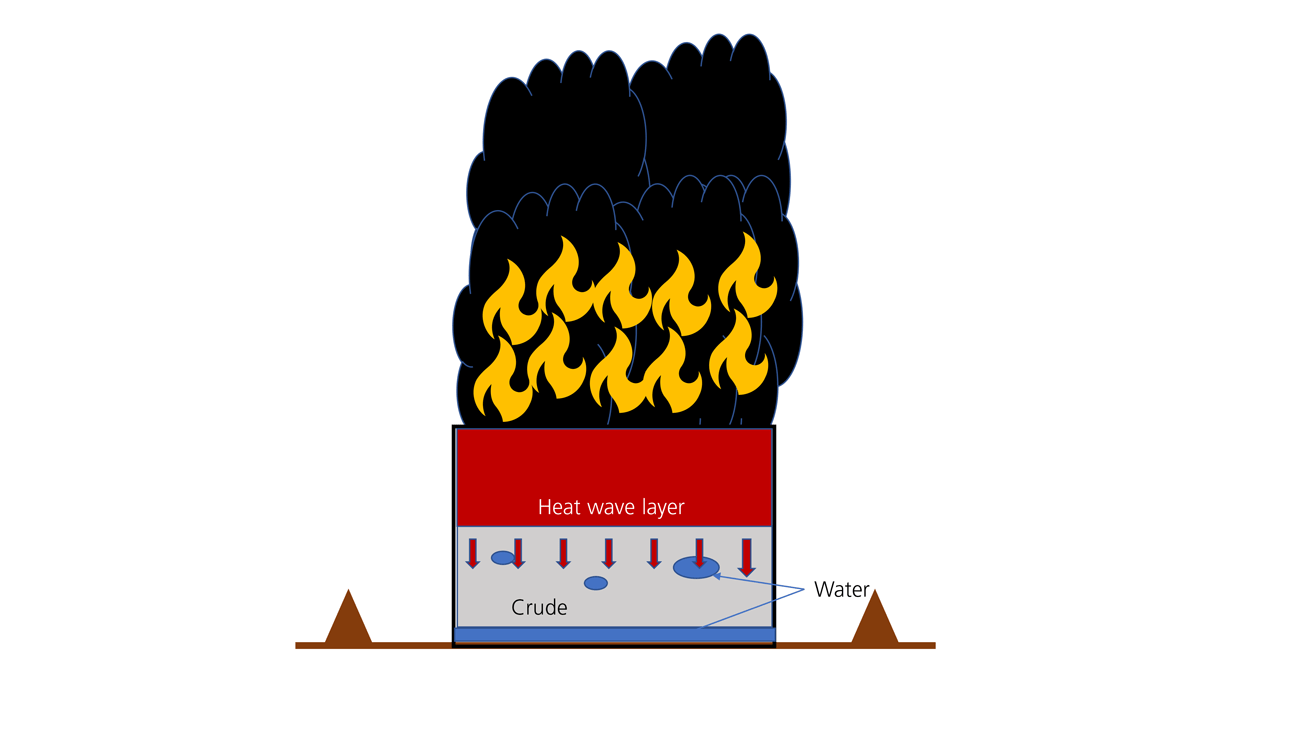
Awareness of this phenomenon should be engrained into the responders, knowledge that this will happen and could happen multiply times. Setting up a mobile attack requires critical planning to ensure enough water, foam, equipment and personnel are in the right place before escalation happens.
This article is not intended to criticise the response in Cuba, but only to emphasis the global failing in understanding and appreciation of what is required to prevent or mitigate major industrial accidents. It starts with competent personnel; good, well-designed systems and procedures; maintenance and testing programmes; and finally clear strategies in dealing these incidents. Take time to invest in the preparedness and not the aftermath.
If you require any further information and want to deepen your knowledge on storage tank preplanning and response strategies, why not enrol on our four-day Storage Tank specialist course. Details can be requested from our customer services department +31-181-376 666 or fireacademy@nl.relyonnutec.com.
About the Author

Stephen Watkins
Stephen Watkins is Business Development and senior consultant RelyOn Nutec.
Former UK Fire Officer in the West Midlands Fire Service, experienced in operations, recruit probationary training and Specialist Fire safety. Joined Rotterdam International Safety centre (RISC) in 1999. Firstly, as a senior instructor delivering command training for the oil and gas sectors, firefighter training for shipping and offshore and since those early days has subsequently provided consulting services on training and response competencies for the high-risk industries, emergency response preplanning, training centre design and Crisis Management in Europe and the Middle East. Played a role in the response planning for small scale LNG incidents in the Rotterdam harbour. 2018 designed and opened the new 3rd generation training facility in Rotterdam (RelyOnNutec Fire Academy, formerly Falck Fire Academy and RISC) to meet the future emergency response training challenges and testing for the foam and energy transitions.