
In the Fire Service when the words Search and Rescue (S&R) are talked about it generally means a couple of different applications from searching inside a structure for a victim or multiple victims to outside searching for a lost person. This article is pertaining to S&R inside structures by locating and removing victims, which requires firefighters to take calculated risks in hazardous situations.
Though it can be very risky for firefighters to conduct S&R there are some factors that will prevent them from doing so, such as a lack of structural integrity or when the fire conditions are so severe that there is no chance of victim survival.
There are two objectives when conducting a structural search: searching for life by locating and removing the victim(s) and assessing the fire conditions by location and extent of the fire. These two require what is called a primary and secondary search. The primary search is done by information gathered prior to entry and very quickly searching in known or likely victim locations. The secondary search begins after fire suppression and ventilation has been completed and these are done much slower and more thoroughly than primary searches.
There are several search techniques, which all depend upon the local Fire Department’s standard operational guidelines (SOG’s) and these can range from a left-hand search pattern where the search is done left-handed all the way around the search area until they have returned to where they started. There is also a right-hand search pattern where the search is all done right-handed all the way around until they have also returned to where they started.
These searches are usually conducted by a search team consisting of one officer and two firefighters or just two firefighters, which can be slow if they are being methodical and thorough since they could be searching a large area. Let’s speed up the pace now and use a 2 x two-person search team which allows them to cover the same area but in half the time with better efficiency. Either search technique is going to take time and there is a very good possibility of not being able to locate the victim depending on their location, possible entrapment and the lack of visibility etc.

It is now time to introduce thermal imaging (TI) into these scenarios, which will allow the firefighters the ability to see sources of heat through the vast unknown darkness and thick smoke. I do want to mention a couple of important points: (1) that there are some limitations when using thermal imaging cameras (TICs) as they cannot detect a person who is under a bed, behind furniture, on the opposite side of a wall as well as the inability to see through glass, (2) the shade of colorization of the victim(s) could range from white through grey to black and is all dependent on the surrounding background, meaning the temperature of the room, so also look for shapes such as head, torso, arms and legs.
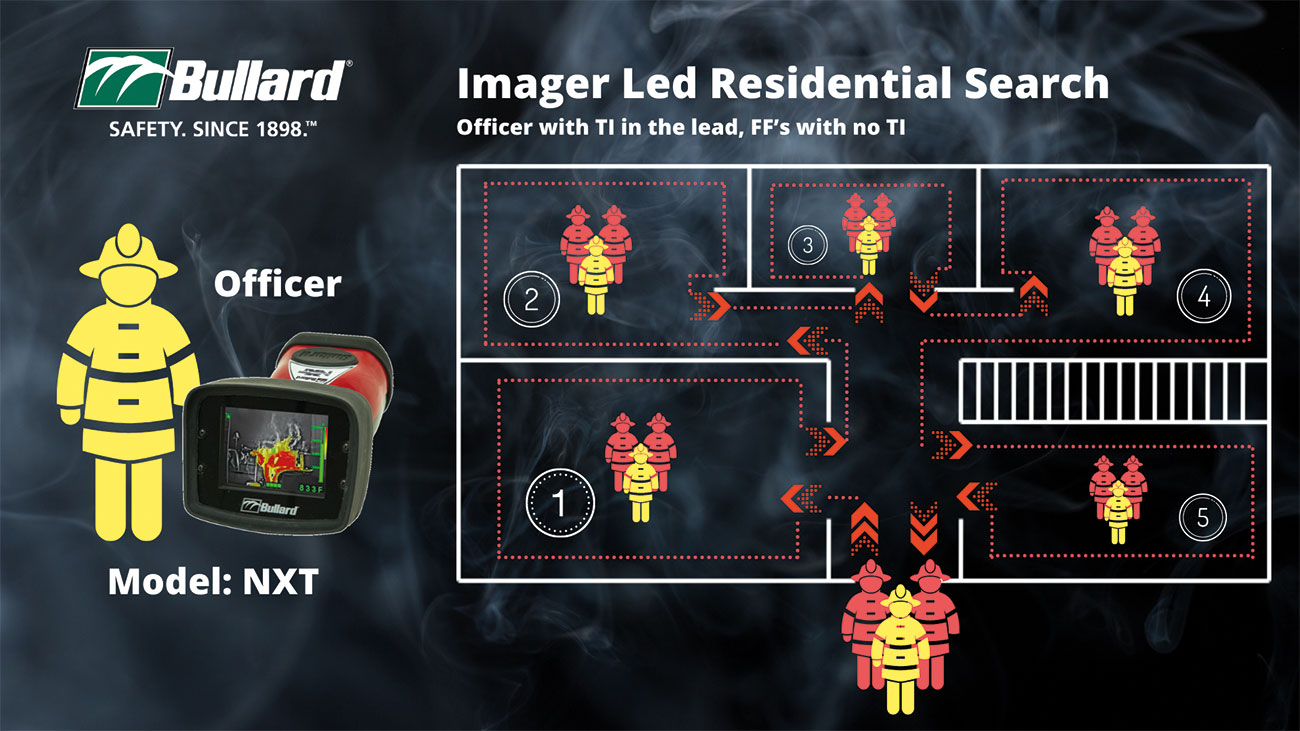
Two search techniques that I like to use are as follows: an imager led search, where the officer has the TIC and leads the search team, giving directions/instructions as they follow along; and an imager directed search, where the officer is at a fixed location such as in the doorway and directs the search team to areas that cannot be seen such as under and behind a bed, behind a dresser and inside a clothes closet. While all this is happening, the officer is monitoring the fire conditions down the hallway for safety and maintaining accountability at the same time. Both of these techniques have drastically improved the speed of the search and safety of the firefighters by using a thermal imager in their searches over the previous conventional search and rescue techniques.
Let’s discuss search techniques with all members of the search team having a TIC. The same scenario as before but now the officer is not the only one having and using a TIC. The search team can move even faster with greater efficiency while still in communication with each other and systematically moving from room to room. The officer would still coordinate and direct the search, but the firefighters have better ability to see what they are doing and where they are. A TI room search would now go like this: the officer is still at the doorway while FF#1 goes search pattern left, FF#2 goes search pattern right and the officer continues to monitor for accountability and down the hallway for safety. Both FFs meet up at the start point of the doorway and then can move from room to room as directed by their officer. Now how much time did that technique save over conducting a conventional search technique without using a TIC?
As I had mentioned previously, using a TIC has limitations, and conventional search techniques should not be forgotten, especially when a FF using a TIC comes to an area such as a bathroom as a TIC cannot see through shower curtains or glass shower doors. Those must be opened and searched behind manually just like under beds and inside clothes closets. Just because you didn’t see anything with a TIC, do not assume there is no one there – leave no person behind.
Reliance on any thermal imager is never 100% as this valuable tool is battery operated, is an electronic piece of equipment which is human-made and even though it is very rare that a failure could occur during operation it is always recommended to stay safely oriented and know your location and follow your Department’s SOG’s.
Incorporating this multi-imager deployment technique and strategy increases thermal imager ownership within your Fire Department and enables it to better protect its citizens, protect property but most importantly protect the lives of its own firefighters while safely improving operations.
Until next time, stay safe and train often.
For more information, go to www.bullard.com
About the Author

Manfred Kihn is a 19-year veteran of the fire service. He has served as a firefighter, captain and fire chief, as well as an ambulance officer. As the Bullard’s fire training specialist for thermal imaging technology, Manfred has been a member of Bullard’s Emergency Responder team since 2005. Manfred is certified through the Law Enforcement Thermographers’ Association as a thermal imaging instructor and he is a recipient of the Ontario Medal for Firefighters Bravery.
