
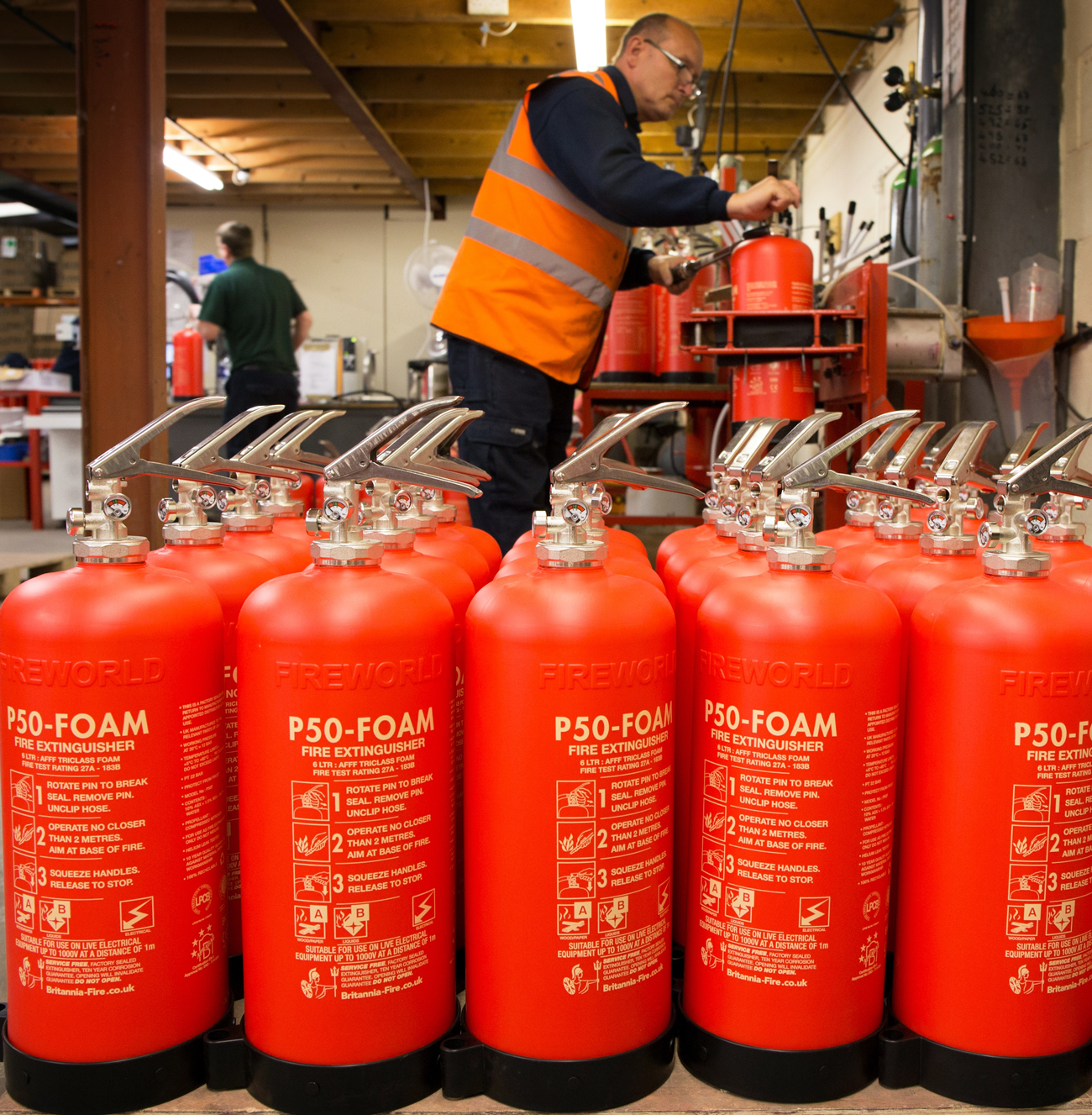
Look around most places you visit – offices, retail, industrial premises – and you should never be more than 30m away from a fire extinguisher.
You’ll often see them in pairs: one extinguisher is generally foam, to be used on materials, and the other is generally CO2, for use on flammable liquids and live electricals. But when there’s a fire, how do you know which to use? Leaving that choice to the ‘lay’ firefighter is fraught with risk.
That made me think… how about if you can have one that did the job of both? Fire retardants have moved on from when the original fire extinguisher was developed, and modern fire retardants work well together to extinguish almost every fire.
Classified as a multi-use fire extinguisher, the contents of Britannia’s P50 will extinguish carbonaceous materials, flammable liquids and live electrical fires.
Multi-use fire extinguishers mean, in the midst of panic or distress, users need no longer check if they’re using the right extinguisher.
So, the P50’s contents differ from traditional fire extinguishers but what about its container?
In petro-chemical and other harsh marine environments, plastic is often chosen over metal for its ability to better resist corrosion. We chose UV protected, high-density polyethylene with UV cured ink.
Within this outer jacket sits an internal bottle, much as you see inside a domestic vacuum flask. For the P50, we chose high-density polyethylene and wove Aramid fibre around it in a specific pattern, which makes it ultra-lightweight, yet strong.
The P50 has a burst pressure of over 70 bar, which is above the standard 55 bar and means it remains fully functional after a big drop. That resilience is made possible as a result of the outer jacket and the hi-tech inner sleeve but also because of the stainless-steel and nickel-plated locking neck ring and headcap, which are also patented. The head cap features double magnetic gauges, enabling users to check the pressure.
The P50 comes with several manufacturer’s guarantees, including anti-corrosion, manufacturing faults and workmanship guarantees.
All this means a P50 is so easy and light, anyone can use it. That’s important when you consider we’re now often expected to work well into our 60s and beyond, and there are more people with disabilities in our workforce than ever before.
So that’s the design element: one extinguisher for all materials – carbonaceous, flammable liquids and electrical fires – in a robust container that’s able to withstand the worst elements that the sea, or any industrial plant, can subject it to.
Now, how do you rethink manufacturing?
Rethinking fire extinguisher manufacture
The way we manufacture has changed since the 1970s – we were less efficient and wasted so much in comparison to the way we work today.
Not just Britannia, but most British manufacturers, are getting leaner and greener as many of us move towards net zero. That calls for examining every stage of your process – from design and procurement through to production and quality assurance.
When you add up everything that goes into every element – both materials and processes – you see how carbon-heavy conventional manufacturing methods vs modern methods are.
Having done the maths, the carbon footprint of the P50 has reduced to be a third of that of one of our traditional extinguishers.
Looking to using less energy, we’ve invested £110,000 in photovoltaic (PV) panels as part of our switch to greener energy. That means we’re set to cut the carbon load of producing a single P50 fire extinguisher by 22%, compared with our metal extinguisher, simply by using the power from the 308 photovoltaic panels on the roof of our factory.
I’m conscious that many people hide behind numbers, so that’s why the figures I’m quoting are statistics verified by the international Greenhouse Gas Protocol – one of the world’s most widely used greenhouse gas accounting standards.
In Table 1 you can compare Britannia’s base period – i.e. Britannia’s manufacturing without green energy – against everything in our control to reduce the carbon footprint of our category-leading P50 extinguishers now using green energy.

Table 1
| Britannia’smulti-use P50extinguisher | Britannia’s metal extinguishers | |
| Britannia’s 2022 Kg/CO2 per unit | 1.29 | 3.31 |
| Britannia’s revised 2023 Kg/CO2 per unit after its PV installation | 1.01 | 2.90 |
% Reduction | 22% | 12% |
Britannia Fire’s calculations, based on the Greenhouse Gas Protocol standard, estimating the total carbon saving in 2023 for both its innovative P50 vs its conventional, portable metal fire extinguishers by using green energy.
When you consider the production journey of a traditional metal fire extinguisher, it has a carbon footprint of circa 3.31Kg, whereas the super-sustainable P50 is only 1.29Kg. That calculation is based on its journey from raw materials to finished product.
Britannia’s PV panels will now save around a quarter (22.5%) of our energy bill, so you could see that current 1.29Kg carbon load drop to circa 1.0Kg.
New machines reduce energy consumption too. To speed up production, while maintaining world-class quality standards, we’ve invested in a new machine that has cut our leak testing from 40 to 18 seconds. That machine’s also British-made, easier to use and more reliable.
Rethinking fire extinguisher service regimes
Think of the carbon footprint of every journey made by a fire service engineer as they drive to a site to give a fire extinguisher its annual regulatory check. Think of all the trips and materials involved in all the discharges for sites such as Heathrow Airport, the Metro Shopping Centre, Manchester Infirmary or an Amazon warehouse.
Think of how all those organisations would prefer to be free of those service contracts and those visits. Free of the cost but also the security arrangements for say airside at Heathrow or in a prison, who are also trying to get to net zero.
What if we could eradicate fire safety engineer visits?
So, we eliminated the need for discharge tests every five years and an annual regulatory check. A P50 needs only be self-maintained once a year by a trained person who checks indicators with a magnet. This radical new way with the P50 is fully credited to Kitemark, PED, MED and EN3.
After ten years’ service, P50 units are returned for refurbishment. After 20 years, its lifecycle comes to an end, and every part is fully recyclable except for its contents.
Future trends
Looking to the future, there’s every reason for optimism. Technology moves on at a pace. New materials are coming to market all the time. Both present opportunities.
Standards continue to emerge and filter out the industry rogues – both manufacturers and operators – thanks to the transparency of the internet.
The multi-use P50 is leading the world with a British-made, patent-protected invention that is quality-assured,* safer and easier to use and maintain and radically reduces the carbon footprint of everyday fire extinguishers. Let’s see what happens next.
The P50 is available in 2Kg, 6Kg and 9Kg.
For more information, go to Britannia Fire or call 01508 488 416.
About the Author

Roger Carr
Roger Carr foundedBritannia Firein the 1970s to design and manufacture fire extinguishers. His innovative and patentedP50design has already challenged assumptions about fire extinguishers in general, and their carbon footprint in particular. Here, he describes how the universal, humble fire extinguisher – fire protection’s front line – makes a big difference to an organisation’s safety, budgets and carbon footprint.
