
Understanding what is required for aircraft hangar fire protection systems, and how to assess the status of these systems, leads to peace of mind for valuable aviation assets and properties.
Owning a Gulfstream G550 jet can cost as much as $50,000,000 with an additional $3,000,000 per year in operating expenses. The hangar used to house and maintain this aircraft can cost more than $100,000 per year to lease, or up to $40 per foot to build. Grant Cardone of Cardone Capital says of private jet ownership, “If you are trying to make sense of just the money you can’t”. But, what it does provide is “less stress and more freedom.” A big part of less stress is the peace of mind that comes with knowing the aviation assets and structures are properly protected.
Protecting aircraft hangar structures against fire is a monumental task, made so by the potential danger of copious amounts of fuel. When building a new hangar, or acquiring an existing hanger it is of critical importance to ensure that fire protection systems are compliant and operational. Moving an aircraft, business, or operation into an existing hangar, only to discover that the hangar is inadequately protected, or is not in compliance with the fire code can lead to unaccounted for expenses and financial consequences.
To prevent this from happening it is important to know what is required and ensure that those required systems have been adequately maintained and are functional. These fire protection system requirements are outlined in NFPA 409, Standard on Aircraft Hangars. All aircraft hangars do not require the same level of protection, rather the protection requirements are based on the hangar classification. Hangars are classified as Group I, Group II, Group III, or Group IV, based on square footage of the largest fire area, and the construction type.

Fire Sprinkler/Foam Systems and Fire Pumps
Group I hangars have three fire suppression system options:
- Foam/water deluge system
- Combination of automatic sprinkler system and low-level low expansion foam system
- Combination of automatic sprinkler system and low-level high expansion foam system
If fire protection option 1 is used, foam/water deluge system, in hangars housing aircraft with a wingspan area of greater than 3,000 sq. ft. supplemental protection is also required.
Supplementary protection systems are designed to cover the area beneath the aircraft being protected. These are typically an automatic monitor nozzle that is tied into the building’s fire suppression system.
For Group I hangars that will house only unfueled aircraft a simple wet pipe automatic sprinkler system or single-interlock preaction system is permitted. To be considered unfueled, the aircraft must meet the definition of NFPA 409, “an aircraft whose fuel system has had flammable or combustible liquid removed such that no tank, cell, or piping contains more than one-half of 1 percent of its volumetric capacity”.
Stand-alone hand hose or foam water stations are required within the aircraft storage area and are required to be installed within the non-aircraft areas of the building.
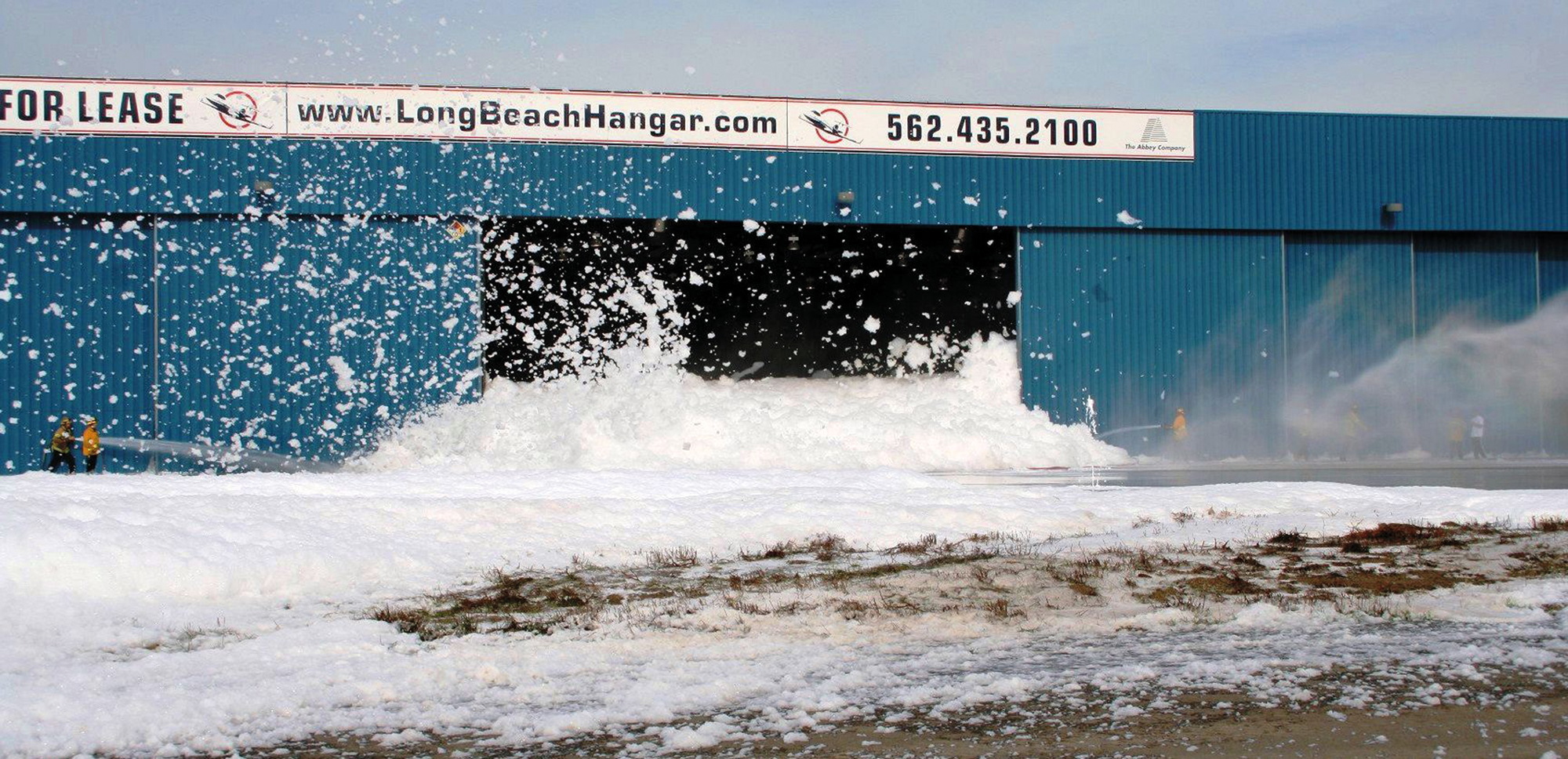
Protection Option 2 for Group I hangars is an automatic sprinkler system, installed in accordance with NFPA 13, Standard for the Installation of Sprinkler Systems. This must be supplemented with a low-level, low-expansion foam system. The third option for protection of Group I hangars is similar to Option 2, however Option 3 requires the system to be supplemented with a low-level, high-expansion foam system. High-expansion foam systems utilize motor driven foam generators to pour down foam from the ceiling. These are also considered low-level as they are designed to cover the entire floor area beneath the aircraft. Differences between expansion rations of foams is outlined in NFPA 11, Standard for Low-, Medium-, and High-Expansion Foam.
A Group II aircraft hangar can be protected using any of the options for Group I, however the system must meet the adjusted design criteria for Group II hangars as stated in NFPA 409, Chapter 7. The difference is in the design criteria and the flow rates of the system. Additionally, a closed-head, foam-water type sprinkler system is permitted. These systems must meet the installation requirements of NFPA 16, Standard for the Installation of Foam-Water Sprinkler and Foam-Water Spray Systems. The same requirements for unfueled aircraft and hand-hose stations apply.
Group III aircraft hangars may not require fire sprinkler protection. A fire sprinkler system is only required under two conditions. The primary condition is based on the adopted code requirements of the local jurisdiction, and fire official. The fire code official can require sprinkler protection. The second condition is based on the hangar’s use. If any hazardous operations are being conducted then sprinkler protection is required. Hazardous operations include, fueling or fuel transfer operations, hot work, cutting, welding, torching, spraying, dipping, or any other similar operation.
Group IV hangar fire protection requirements are based on square footage and the ‘fueled or unfueled’ status of the stored aircraft. If the hangar is larger than 12,000 square feet, housing fueled aircraft then a low-expansion, or high-expansion sprinkler system with hose stations is required. If the hangar is greater than 12,000 square feet, and storing unfueled aircraft, the hangar must be protected with a low-expansion or high-expansion system, or a standard closed-head system with manual hose stations.
For Group IV hangars greater than 12,000 sq.ft. housing fueled aircraft the following fire protection systems are required:
- Low-level low expansion foam system with foam/water hand-hose station
- Low-level high expansion foam system with foam/water hand-hose station
For Group IV hangars greater than 12,000 sq.ft. housing unfueled aircraft either of the options for fueled aircraft can be used, or a closed head system, wet or pre-action, can be utilized. A hose station and standpipe system is required in the aircraft storage and servicing areas.
Those Group IV hangars that are less than 12,000 sq.ft. must meet fire protection requirements comparable to the requirements for Group III hangars. Systems are not automatically required, and may be omitted, unless they are required by the fire code official or hazardous operations are performed within the hangar. If a system is required it can be a simple automatic sprinkler system installed in accordance with NFPA 13. Hose and standpipe systems are required in all non-aircraft areas.

Fire pumps may be required to provide needed water flow. Fire pump requirements are specifically stated for Group I, Group II, and Group IV aircraft hangars. Fire pumps must be installed according to the following criteria:
All pump installations are to meet the requirements of NFPA 20, Standard for the Installation of Stationary Pumps for Fire Protection.
- A minimum of two fire pumps is required.
- Pumps are required to auto-start. This can be via pressure drop, or signal from a detection control panel.
- If the pressure drop method for pump starts is used, a jockey pump is required to be installed.
- Fire pumps must be stopped manually. They cannot be set to ‘auto-stop’.
- An audible ‘pump running’ alarm is required. This alarm is to be transmitted to a constantly attended location.
When evaluating an existing fire sprinkler or foam system all components must be considered. These system components and functions include, number and types of systems, system test data and inspection reports, piping and sprinkler head condition, foam status, and system access.
Assessment of these systems should include a review of the most current system inspection reports. These inspections should be conducted, and documented, in accordance with NFPA 25, Standard for the Inspection, Testing, and Maintenance of Water-Based Fire Protection Systems, for fire sprinkler systems, and NFPA 20, Standard for the Installation of Stationary Pumps for Fire Protection, for fire pumps. Also, the specific, and more stringent, hangar fire protection system inspection, testing, and maintenance requirements outlined in NFPA 409, Chapter 11, must be applied. If these inspections are current and reports are available, this is a good indicator that the property has been well maintained. These inspection reports will show any issues or deficiencies that exist in the system. Additionally, these reports can be used to review the history of what problems have been encountered and how they were corrected.
Fire Alarm Systems
A fire alarm system is required based on the fire sprinkler systems installation. The fire protection options require an actuation device – smoke, heat, flame detector – that must be monitored by a fire alarm system, as well as, a manual actuating means. All sprinkler components (tampers, flow switches) are required to be monitored and supervised. Any alarm components are required to be installed in accordance with the requirements of NFPA 72, National Fire Alarm and Signaling Code.
An assessment of an existing fire alarm system must include a visual examination of the fire alarm panel and general condition of the alarm devices and components. The fire alarm panel should be clear of any “trouble”, “supervisory”, or “alarm” signals. These indicate a problem within the system. NFPA 72, requires quarterly, semi-annual, and annual inspection, testing, and maintenance of fire alarm systems. These inspection reports and testing documents should be reviewed. Any deficiencies noted should be repaired, or confirmed to have been repaired.
Fire Extinguishers
Wheeled and portable fire extinguishers are required throughout aircraft hangars, and must be installed per NFPA 10, Standard for Portable Fire Extinguishers. The distribution and selection of the fire extinguishers is to be based on an analysis of each area to be protected. Due to the corrosive properties of ABC multipurpose dry chemical fire extinguishing agents, ammonium phosphate, NFPA 407, Standard for Aircraft Fuel Servicing, prohibits these types of extinguishers from installation on fueling vehicles, fuel facilities, servicing ramps or aprons, or within 500 feet of aircraft operating areas.
Fire extinguishers within the hangar should be evaluated to determine proper type, location, accessibility, and general condition of each unit. Fire extinguishers required annual maintenance, and a six-year or twelve-year maintenance and hydrostatic testing. Documentation of these tests and inspections should be found on the extinguisher in the form of tags or labels.
Future Direction
As the aviation industry and flight products continue to evolve, so must the fire protection systems and strategies that are used. Development of new technologies for flight, such as electric, hydrogen, and hybrid based systems, may potentially eliminate the “fuel” based fire hazards. These advances may lead to situations in which a required foam system is impractical, counter-productive, or even dangerous. Current proposals within the codes and standards and aviation communities reflect these concerns and are considering a more risk based approach to hangar fire protection. This approach would allow a design professional to evaluate the hangar, the aircraft, and its intended functions and activities, and then develop a performance-based design that would address all potential hazards.
Those of us in the aviation field belong to a tradition of people who shed blood, sweat, and tears to make flight possible. As technology within the aviation world continues to evolve, protecting these aviation assets and properties ensures that our work toward this mission will continue.
For more information, go to www.AaronJWriter.com
About the Author

Aaron is a Chief Fire Strategist specializing in innovative fire protection solutions for emerging technologies. He has more than 15 years of fire protection, life safety and code compliance experience. He is a leading authority on fire protection for aviation facilities and is actively involved in the codes and standards development process.
