
Not all pumps referred to as a fire pumps are the same. Choosing the correct pump for the specific job is complicated, because the name fire pump is used to describe a wide range of different styles and designs of pumps; all of which are used for different applications that are regulated by different standards.
There are fire pumps in boats and ships; buildings and plants; in fire apparatus’ of many different types; and in portable self contained packages, such as skids, trailers and PODs. All of these applications require a different pump design and must meet different regulations and standards.
Marine vessel applications can basically be divided into internal fire protection and external fire fighting systems. The internal systems are for self-protection and include: small portable fire pumps, ultra-high pressure fixed systems and normal pressure fire hose stations located at various places on the vessel. Most of these systems have a fixed performance and can be automatically or, in some cases, manually activated. These internal built in systems are highly regulated and covered by a variety of specific standards from the following organizations: NFPA, ABC, ABYC, EN, ISO among others. This is a very specialized market segment.
External firefighting systems can be used for attacking fires onshore, on drilling rigs and on other vessels. They can be as basic as a portable pump mounted on a small boat. However, they are more commonly built in systems designed to meet NFPA1925 (Standard on Marine Fire-Fighting Vessels), or equivalent standard, or perform to the FiFi requirements and have the pump type tested by ABC, or equivalent organization.
NFPA is a North American standard used for municipal fire boats. NFPA1925 has pump ratings of 500 US GPM (2000 LPM), 1500 US GPM (6000 LPM), 4500 US GPM (17,000 LPM), 10,000 US GPM (38,000 LPM) and 20,000 US GPM (76,000 LPM). FiFi is an international performance standard most commonly used for vessels protecting drilling rigs and dry dock facilities. FiFi performances are as follows: FiFi 1/2 is 5230 US GPM (1200 m3/h), FiFi1 is 10,560 US GPM (2400 m3/h), FiFi2 is 31,680 US GPM (7200 m3/h) and FiFi3 is 42,240 US GPM (9600 m3/h).
These pumps do not normally draft water and most of the larger pumps do not operate smoothly at low flows, such as during a hand line operation, without dumping large quantities of water off the back of the vessel. Many of these pumps are based on standard industrial process pump designs. To get the desired maximum flow, some fire boats have been built with multiple fire apparatus derived pumps in order to obtain the overall performance flexibility to operate at low flows or at higher pressures than those available from a single big process type pump.

Building and plant fire systems are fixed systems designed to feed standpipes, connections for hand lines, or to feed fire apparatus or fire trailer packages, sprinklers or fixed monitors. By design the fire pumps utilized in these systems operate at a fixed flow and pressure. When the system is activated, whether automatically or manually, the driving source, either an electric motor or a diesel engine, starts and ramps up to a fixed speed. Flow and pressure is controlled at the individual line outlets by automatic valves. Commonly these systems do not draft water, if the water source is static a submersible pump, called a vertical turbine pump, is used to lift the water to the system, and in most cases, is then boosted to operating pressure by the fire pump.
These pumps are commonly covered by NFPA20 (Standard for the Installation of Stationary Pumps for Fire Protection) and are listed by ULI and approved by FM. Most of these pumps are based on standard industrial process pump designs. The traditional industrial process pumps are designed specifically to operate with a fixed flow and pressure entering the pump intake. They then add the power from the drive source at 1800 RPMs to produce a fixed flow at a higher pressure coming out of the discharge.
Yes, they will work to some degree under other conditions but at a narrow window of performance and still operate smoothly. Lift in particular is a problem for these process pumps, because in a normal industrial plant setting there are no drafting operations.
Apparatus fire pumps by design are different than the above mentioned fire pumps because they must operate at rated performances from a specific drafting condition, and offer some performance at drafting lifts as high as 25ft (7.5M). Additionally they must be able to pump from a pressurized water source as high as 200psi (13.7Bar). Whether drafting or operating from a pressurized source these pumps must be able to flow from 0 to 100%, or more, of the pump rated capacity at a range of pressures from 60psi (4Bar) to over 300psi (20Bar).

From a sufficient pressurized source it is expected to perform at up to 150% of the rated capacity. When rolling up to a fire, the performance required and the water supply can vary considerably. However, the fire still needs to be controlled and at a smooth and even output. This wide range of performance under a wide variety of suction conditions is required to give the fireman the flexibility needed to cover all the emergency conditions they could encounter.
Additionally, fire pumps designed to be used on a fire apparatus must have the capability of being mounted and driven by a chassis engine driven power take off. All of this requires a special pump designed for the application.
Fire Apparatus pumps are covered by the following standards: NFPA1901 (Standard for Automotive Fire Apparatus), NFPA1906 (Standard for Wildland Fire Apparatus) and NFPA414 (Standard for Aircraft Rescue and Fire-Fighting Vehicles) in the NA driven markets or EN 1028 (Standard for Fire-Fighting Pumps) for European driven markets.
A pump designed for mobile firefighting applications will also have a variety of available options and features to make the installation and applications work more effectively. They include: an all bronze pump end option for operating in sea water conditions, a variety of gear ratio options to tailor the pump performance to a variety of engine mounting points to accommodate vehicle installations; suction intake and discharge outlets to accommodate fire apparatus plumbing and valves; rotatable gearbox and volute to accommodate vehicle installations; pump end designed to withstand a 500psi hydrostatic test to provide resistance to water hammers; and most importantly a volute and impeller designed to provide the performance flexibly needed for the firefighter under a wide range of conditions.
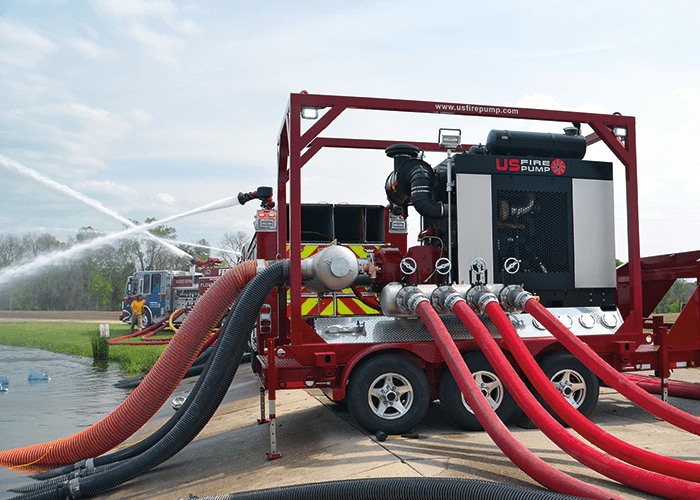
Portable pumps are self-contained packages ranging from small gasoline driven pumps with a 5.5HP engine to a 750HP diesel powered skid package. These packages can be used for water supply or even dewatering; however, fire pumps should be designed to duplicate the performance of a fire apparatus. Smaller portable fire pumps are primarily used for fighting fires in inaccessible areas where a fire apparatus cannot respond.
These portables are normally designed to be carried by four or less personnel and are limited due to weight to about 100HP or less for a gasoline engine or about 35HP for a diesel engine. Larger portable pumps are designed as a lift able skid or POD, but are commonly mounted on a trailer. These packages are often used at port facilities, oil refineries, industrial plants, or by military facilities. Performance can be as high as 6250 US GPM (23,500LPM) and still meet the requirements of NFPA1901 that apply to this type of package. If it is expected to operate in place of a fire apparatus then it should perform like a fire apparatus with all of its relative features and full range performance flexibility. If operating as an apparatus then it should perform to the same standards where applicable.
The overall theme of this article is to buy a pump based on its application and apply the appropriate standards for that application. NFPA20 pumps do not go on any mobile or vehicle applications.
Marine vessel applications are highly regulated; municipal fire boats should look very closely at the NFPA1925 standard while considering also meeting FiFi performance standards. Commercial vessels should follow the applicable internal fixed systems regulations
If you are building a fixed fire system in a building to feed sprinklers, hydrants or standpipes buy a process type of pump designed to meet NFPA20 or equal standard. If you are building a fire apparatus, a trailer or POD firefighting package buy a fire pump designed for the duty to the NFPA1901, NFPA1906, NFPA414, EN1028 or equal standard.
For more information, go to www.usfirepump.com
About the Author

Gary has been in Fire Equipment Industry for over 44 years, and has worked for various fire apparatus or fire pump manufacturers, holding positions in engineering and product management, and is currently President of US Fire Pump. He has had the opportunity to visit over 247 different fire apparatus factories and to be a speaker or an instructor at events around the world. Additionally Gary is active in NFPA 1901, 1911, 1912 and 1925 for more than 25 years, and was a member of the NFPA Fire Apparatus Committee for 20 years.
