
As the world moves away from fossil fuels, hydrogen has become attractive as a clean alternative. It is already a vital component in our economies and has been used for centuries in many industrial applications, such as power station cooling and semiconductor processes. However, its use as a fuel has its challenges from a production, storage and safety point of view. This article explores these challenges related to emergency response and discusses what can be done to overcome them.
The fuel of the future?
Global production of hydrogen is currently around 70 million tonnes each year. The need to limit the global average temperature rise to 1.5°C is forcing more aggressive decarbonisation. This is having big impacts on sectors such as marine and aviation – sectors that are hard to decarbonise through electrification. Hydrogen fuel cells and electrolysers offer an excellent alternative to the well-publicised lithium-ion battery transportation and energy storage systems. The main benefit of using hydrogen is that the only by-product is water meaning much cleaner vehicles, better air quality and an improved environment.
The global sustainability strategies put forward by many governments have made it very clear that hydrogen is a fundamental part of the future and are investing in research and deployment by the 2030s. For example, Ricardo has joined a group of leading UK businesses – which have together committed to investing £3bn into hydrogen projects.
The technology behind electrolysers has been available since the 1800s so is well developed. However, it is a challenge to produce what is termed ‘green’ hydrogen, formed from renewable energies such as wind and solar, at a cost-effective price. Most of the hydrogen produced today is comparatively cheap, but 95% of it is currently made from fossil fuels.
Since most uses of hydrogen today are industrial, the regulations and safety standards have helped to limit workplace incidents. Staff involved with its production, storage, transportation and use are trained in the properties and hazards of hydrogen, so they are aware of the safety implications, as well as how to safely respond when an incident does occur.
However, if hydrogen is going to be used more widely as fuel for mass transit and shipping, all potential users need to be aware of the safety standards and associated hazards. Emergency responders also need to be prepared for the increase in hydrogen production and use and train for any related incidents as the likelihood of emergency incidents will increase over the next decade.
Hydrogen safety and incident response
NCEC’s emergency response experts have been considering the safety and incident management of a world where hydrogen is widely utilised. Working alongside partner organisations they have been developing training material to assist anyone involved with hydrogen, from awareness to more specific emergency response training to help the global community prepare for the emerging technology. Below they highlight some of the main challenges to be addressed when it comes to hydrogen safety, namely its flammability and compatibility with existing infrastructure.
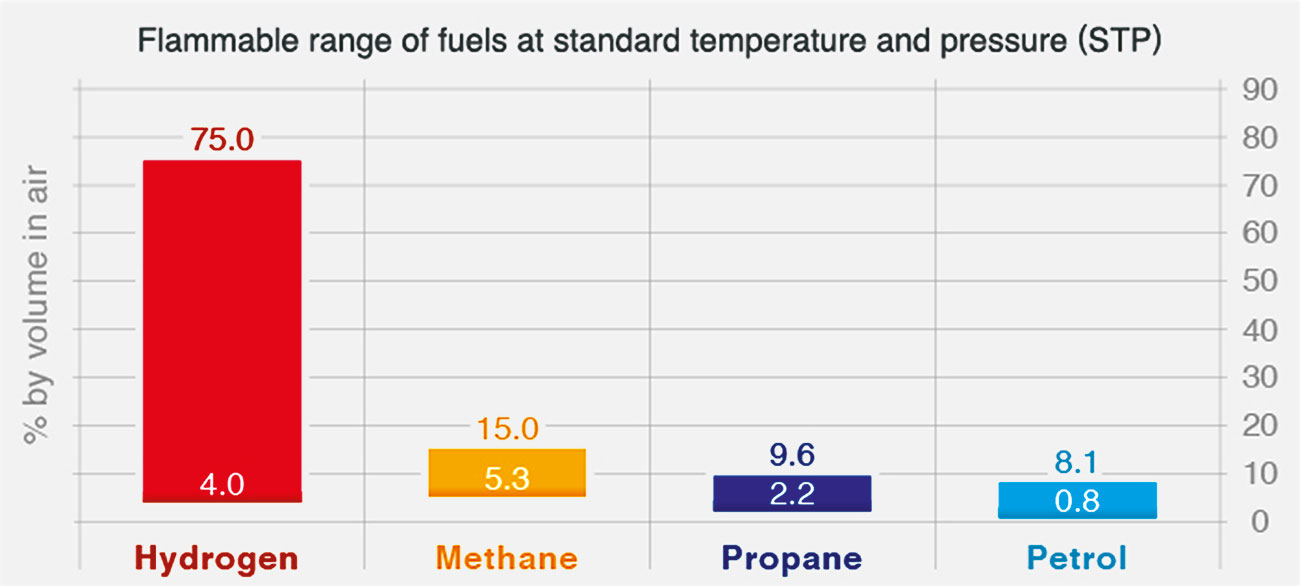
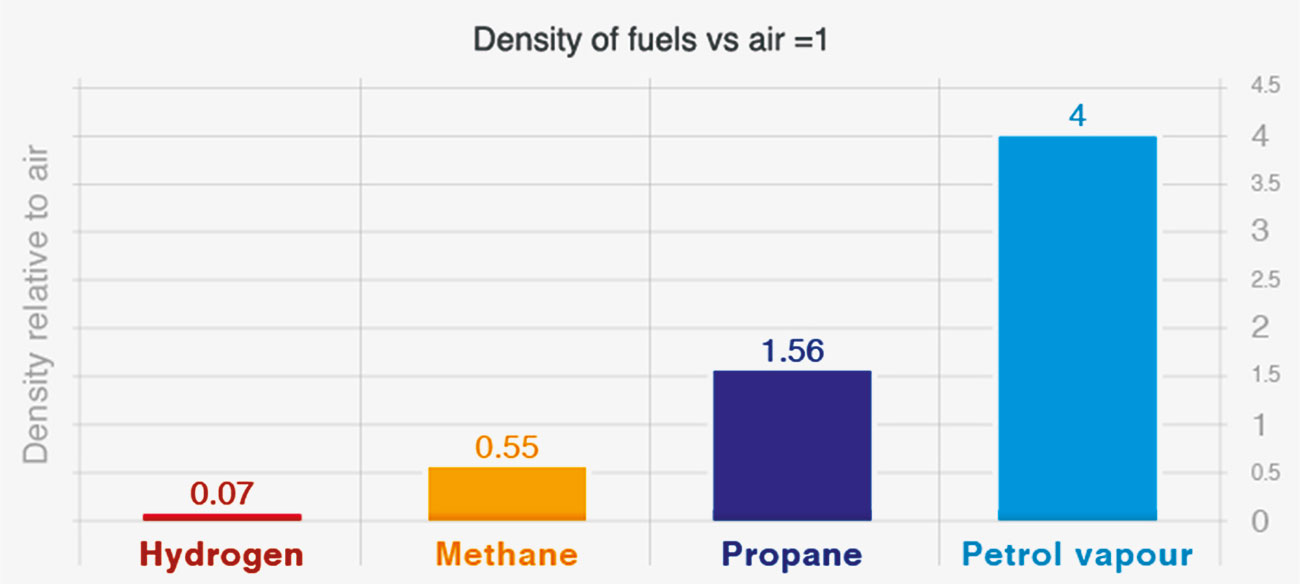
Hydrogen is extremely flammable with a very broad flammability range of 4% to 75%. In confined spaces such as tunnels or bus depots, it can form an explosive atmosphere when mixed with air. It is very light and will disperse rapidly into the atmosphere if allowed to do so, meaning that venting can be an extremely useful tactic if a hydrogen leak or flame is found. But care needs to be taken when venting a confined space as this could bring the volume of hydrogen back into this range, risking a potential explosion. Incidents such as fires involving hydrogen-fuelled buses have already occurred, and mostly the safety systems worked well to prevent loss of life although in one case the bus depot was burned out.
A hydrogen flame radiates very little heat when compared to common fuels like propane or butane and is almost invisible in daylight, so you must be extremely close to feel it. This is why hydrogen detection equipment or thermal imaging is so important to visualise a hydrogen leak or fire. This equipment is required for industrial use but is not likely to be available everywhere hydrogen could be used in the future, for example in vehicles, service stations and homes. This is a challenge that will need to be addressed alongside the deployment of hydrogen.
Hydrogen blends are already being supplied through gas networks to households. All five UK gas grid companies have stated they will be able to deliver up to 20% hydrogen gas blends throughout the country by the government’s target date of 2023. Testing for this has been carried out by the UK government body responsible for health, safety and welfare and trials are already underway. The biggest concern here is the compatibility of hydrogen with various materials such as metals and plastic pipelines already used for natural gas. Hydrogen can cause defects to certain materials through processes such as hydrogen embrittlement at low temperatures (below 150°C), and hydrogen attack at higher operating temperatures (above 200°C). Therefore, regular maintenance checks are necessary to spot any material weakness or damage to prevent leaks. Hydrogen easily leaks because of its nature and making sure that these leaks can be detected and resolved easily is a big challenge for the future of the hydrogen industry and emergency responders.
As vast quantities of hydrogen will be needed in the future, there will also be a need for contemporary solutions to store it. One option is to use ammonia (NH3) as a source of hydrogen as it is easy to store in comparison to similar quantities of liquid hydrogen. Ammonia’s molecular structure is formed of three hydrogens and one nitrogen, so it has high amounts of hydrogen available. It is, however, toxic, corrosive and flammable. Additionally, decomposition is the method used to release the hydrogen from the ammonia, but it is not usually possible to decompose the ammonia fully. It is then difficult to remove the residual ammonia that hasn’t decomposed from any hydrogen produced. For use in hydrogen fuel cells, the hydrogen needs to be clean of contaminants, which limits the potential uses of ammonia storage. Using ammonia as a source for hydrogen storage also presents its own safety and incident response challenges. These are important for emergency services to understand.
Hydrogen also provides much less energy by volume in comparison to current fuels. This can be addressed by using increased pressure to achieve a greater volume in the same space. With further research into hydrogen storage, it is hoped that higher pressures can be achieved, which will allow for smaller tanks or longer ranges. In worst-case scenarios, these increased pressures could result in catastrophic failures compared to the emergencies that current fossil fuels present. Preparedness is essential for all emergencies, training and awareness are required for these new hazards.
Hydrogen’s physical properties and its use bring advantages and challenges. As the need to manage hydrogen incidents increases, so does the need for awareness and training of users and responders.
Overcoming the emergency response challenge
Hydrogen could revolutionise the world in terms of transportation, power and technology and the shift to this cleaner fuel has already begun, but it comes with safety issues that will present emergency services with significant challenges. These can be mitigated by immediate collaboration with industry, safety organisations and quality training.
For more information, go to www.the-ncec.com

Ed Sullivan

