
ydrogen has the potential to help reduce our dependence on fossil fuels; however, its use is not without risk, particularly from a fire-detection perspective.
In normal conditions people cannot, see, smell, or taste hydrogen gas leaks. Hydrogen, however, is very flammable (4% to 75% by volume in air) and requires only a small amount of energy to ignite it. The energy to ignite it is indeed so low that a high-pressure gas leak can self-ignite!
Hydrogen flames emit a pale blue, near invisible flame. This lack of colour makes it almost impossible to visually detect hydrogen flames, especially in well-lit environments. Hydrogen flames can look like the heat shimmer you see surrounding aircraft on a runway, they also can appear to emit sparkles, and both features can play havoc with a human’s perception of what is happening.
Hydrogen flames also have lower radiated heat than their hydrocarbon alternatives meaning site operators cannot feel the heat of the flame quickly and so may be at greater risk when walking around a hydrogen gas process facility. This paper discusses the evolution of methods used to detect hydrogen flames in hazardous process industries.
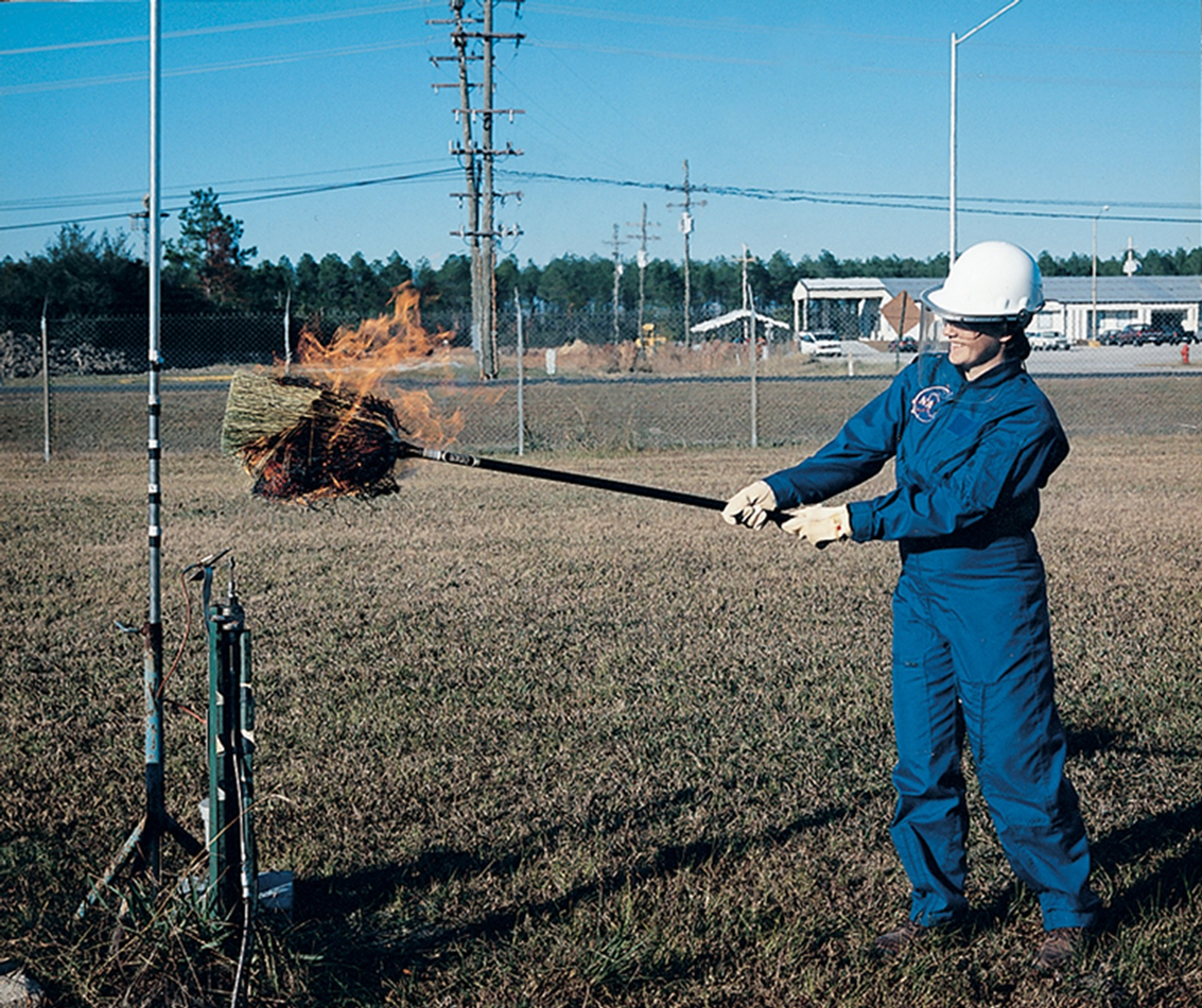
The broom test
Workers at NASA historically used a broom held out in front of them to detect hydrogen and alcohol flames. The broom, which comprised dry grass strapped to a pole was held out in front of a worker and used in a sweeping movement at arm’s length. The broom test served two purposes: it burns brightly showing the flame’s location and it keeps the worker at arm’s length from the flame.
Although an effective means for detecting hydrogen fires, an automated method was needed.
The first automated method – UV flame detection
UV flame detection has been used since the early 1970s. Most UV detectors use a sensor (Geiger-Müller) tube that detects radiation emitted in the range of 180 to 250 nanometres (nm). UV flame detectors can respond very quickly to fires as their detection mechanism is simply related to the number of photons (light energy) being received by the detector each second. Once the pre-set threshold has been exceeded the detector alarms.
Virtually all fires emit radiation in this band, while the sun’s radiation is absorbed by the earth’s atmosphere. The result is a detector that is solar blind.
UV detectors are sensitive to most fires, including hydrocarbon (liquids, gases and solids), metals (magnesium), sulphur, hydrogen, hydrazine and ammonia. It should also be noted that some gases and vapours inhibit detection, e.g. toluene and that optical contamination, e.g. oil mist, dust, dirt and sand, can blind the detector.
Whilst UV detectors are good general-purpose devices, they do have false-alarm issues with arc welding, lightning, X-rays, sparks, arcs and corona. This proved to be a major disadvantage, so some manufacturers developed a ‘remote surveillance controller’ system to significantly reduce false alarms caused by UV interference that is generated by sources outside the protected area.
The principle of operation for the surveillance system was straightforward. UV detectors were used in pairs, one looking towards the area to be protected, the other looking away. Therefore, if a fire occurs in the target area, the photon count from that detector must be higher than that of the paired surveillance detector and an alarm is generated. Conversely, if the photon count from the paired surveillance detector is greater than the active detector then the system does nothing.
The main issue with this approach is the duplication of cables and detectors – the solution was therefore expensive to implement. The other drawback were the issues associated with the use of a UV device, in particular devices being affected by optical contamination.
Alternatives to UV flame detection
Historically people have moved away from the use of UV detectors to those based on infrared technology. This was quite straightforward for hydrocarbon fires as the detectors in general respond to the hot carbon dioxide emitted by a flame and, as it happens, the main infrared detection band is solar blind – in other words, sunlight does not affect detector response. Things, unfortunately, are not quite as fortunate for hydrogen fires.
When hydrogen burns, the products of combustion are hot water vapour, 2H2 + O2 = 2H2O.

The challenge for infrared flame detectors is the wavelengths for the detection of water vapour do have some solar sensitivity. This is the main reason why you do not see single-frequency infrared flame detectors for hydrogen fires.
Manufacturers tackled this challenge in two ways: firstly by combining a single frequency infrared sensor with a UV detector, and secondly to combine the response from multiple infrared sensors.
UV-IR flame detection
As it sounds UV-IR flame detection is the combination of both UV and IR flame detection technologies. UV-IR flame detectors employ a solar blind UV sensor with an IR sensor and filter matched to the desired fire/fuel type. The response characteristics of the detector are determined by the IR wavelength selected. Typically, this will be 2.7 microns for hydrogen fires.
UV-IR flame detectors are very resilient to false alarms as the UV and IR detection technologies share few false-alarm sources. However, care should be taken when using these devices as there are numerous factors that can inhibit the detector’s response, for example, optical contamination, airborne solvents, as well as water and ice on the detector optics.
Triple-infrared detection
A triple-IR detector has three sensors, each sensitive to a different IR wavelength. The IR radiation emitted by a typical hydrogen fire is more intense at the wavelength accepted by one sensor (as we have seen typically 2.7 microns) than the other two, which monitor adjacent spectral bands (guard bands) for false alarms. With other sources of radiation (e.g. heaters, lamps, sunlight) this is not the case, as the intensity at 2.7 microns is no greater than the intensity of at least one of the guard bands. Electronic circuitry in the detector translates the information received into data that can be analysed for:
- Flame flicker analysis
- Threshold energy signal comparison
- Mathematical ratios and correlations between various signals.
Triple-IR detectors are virtually immune to false alarms and can have extremely long detection distances to some fire types. There are, however, wide performance variations from brand to brand, with regards to detection distances and response times. No two triple-IR detectors are the same. The fire and gas design engineer must carefully review detector performance for their application, specifically for detection distance to the fire type of interest and speed of response.
When compared to UV-IR detectors, the IR3 detector, although slightly higher in cost, provides greater area coverage meaning that few detectors are needed to cover the same risk and so the overall installation cost is lower.
Today, triple-IR detectors are used widely for hydrogen flame detection, but are process facilities any safer for the workers on site?
Is the broom test more useful than using an optical flame detector?
We now have highly reliable optical flame detectors that can immediately alert personnel to a flame within a facility, but hydrogen flames are invisible to the naked eye, and so first responders don’t have a clear idea of the fire they are faced with, or do they?
FGD can detect hydrogen flames quickly, with industry-leading false-alarm immunity and uniquely our FLS-IR3-H2-HD detector. The detector can clearly show moving hydrogen flames and explosions, at 30m, even in bright sunlight, this enhancement allows operators to direct site personnel more safely around a facility. The FLS-IR3-H2-HD detector can also record the fire event for up to four minutes, this valuable information can be used for post-incident investigation.

That’s right, remote detection and visual confirmation of a hydrogen flame is now possible from the relative safety of a control room.
Summary
This paper has discussed the evolution of methods used to detect hydrogen flames in hazardous process industries, starting with the broom test and concluding with triple-IR flame detectors with embedded near IR cameras that can present a live video feed of the flame to a control room operator.
About the Author

Dr Eliot Sizeland C.Eng MInstMC is Vice President of Business Development, Fire & Gas Detection Technologies, Inc.
