
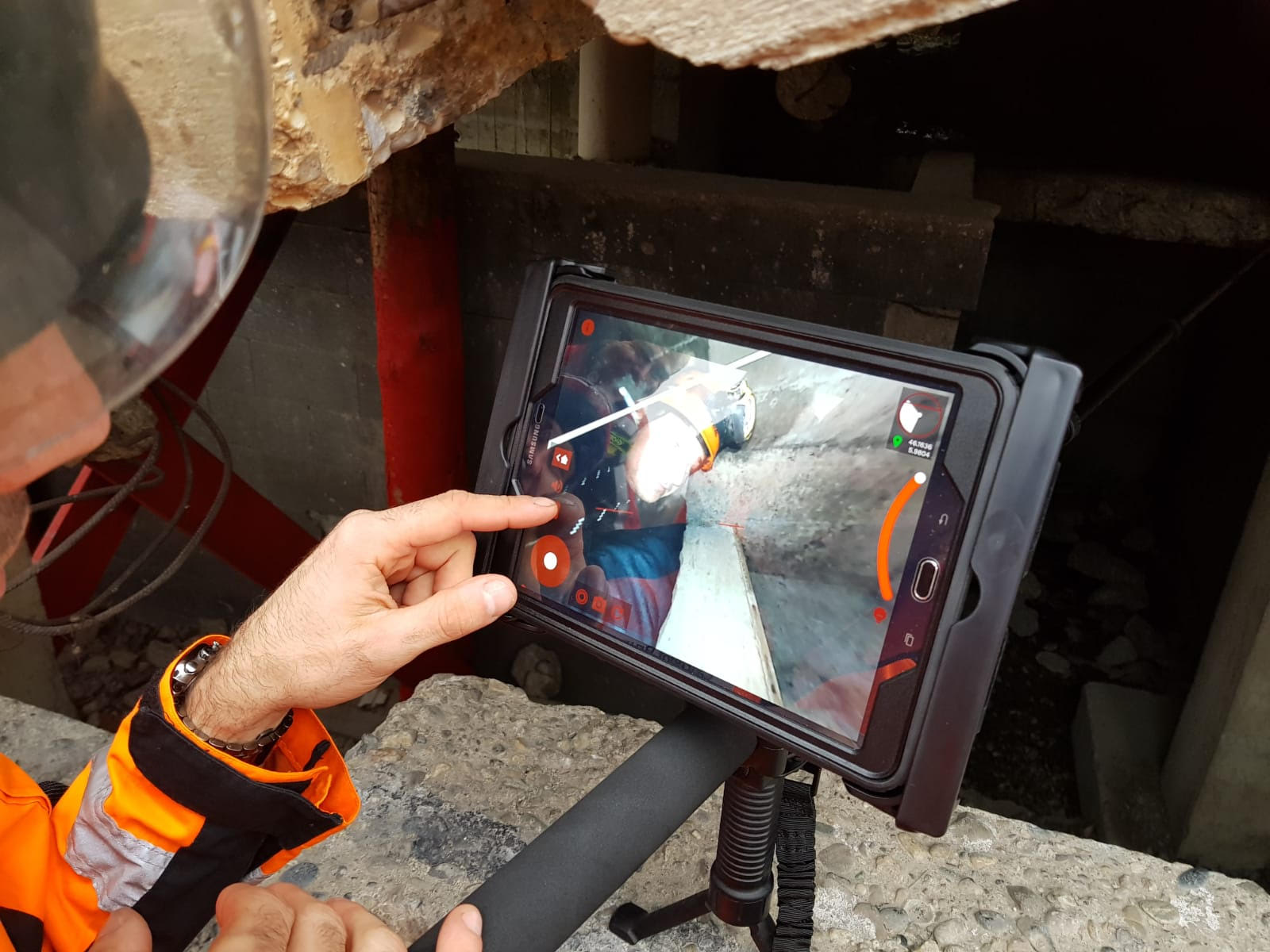
As critical as search cameras are to an Urban Search and Rescue (USAR) team, it can also be said that they’re just as important to a Technical Rescue (TR) team’s operation. Some fire departments are often pigeonholed into thinking they’re only for USAR but that’s not the case. Whether it be vehicle extrication, confined space, structural collapse and/or water rescue, having another set of eyes could possibly enhance victim assessment, improve safety, provide situational awareness and, more importantly, bolster rescue outcomes. With the introduction of wireless 360° spherical image technology by FIRSTLOOK, the FL360 Search Camera gives a TR team a tool that is adaptable/multipurpose providing more information than ever before. Let’s break down why rescue operators would use this technology in the above-mentioned rescue applications.
Vehicle extrication
The process of removing a victim from a motor vehicle accident needs a very delicate approach. When using cutting tools, it can be difficult to see how the operation of the tool can affect the victim. Using an articulating search camera for a better view is often not feasible due to the room needed for the camera head to manoeuvre but using 360° spherical imaging is a different story. There are no moving parts, and the camera can be placed in any space to view any angle. The operator can manipulate their view as they see fit and allow for a safer removal of material so as to not injure the victim further and allow for a safer extrication.
Extrication can also involve the need for patient assessment. If there are severe injuries and some of them are not clearly visible due to the wreckage, why not try to use a camera to assess those injuries. The use of a camera can affect the outcome and more importantly present solutions that might save the victim from possible demise.
Confined space
The rescue of victims trapped in a confined space such as vaults, silos, tanks and/or sewers can be extremely complicated. The rescue team need to account for lighting, space, air quality and time. For spaces where air monitoring is essential, the use of intrinsic safe/ATEX approved products is required and most search cameras currently offered don’t have that level of certification so they can’t be used. That said, in the case of a well-ventilated space(s), the operator can lower a search camera like FL360 to be used to monitor the victim by way of two-way communication and visual including the actual rescue team. The FL360 features key spatial orientation features that allow the operator to see where exactly they’re looking within the space, which is important when choosing which equipment to use to extricate the victim.
Structural collapse
For the very reason that search cameras exist today, a structural collapse whether natural or man-made is extremely daunting and many local TR teams should have the training to respond. When they do, there’s a list of safety protocols that are checked off before search specialists can begin traversing the rubble pile.
As long as there have been USAR teams, there have been search cameras and the technology really hasn’t changed all that much in that time. A fixed camera head on a pole moves left and right using small mechanical gears and a small screen for viewing. Articulating cameras take time to view spaces and the process of spatial orientation comes into play – where am I looking in the space? If the camera enters the void space and is no longer visible, it can be tricky to determine whether you have searched the entire space and where exactly you are looking. This process can take time.
With the addition of 360° spherical imaging and the FL360 camera, spatial disorientation is a thing of the past. In addition, the speed at which a team can view void spaces has greatly increased. These features along with cost and the small footprint of the system is reason enough to have search camera on any TR team.
Water rescue
With the increase in flooding and water-related rescues in recent years, many TR teams have had to add more equipment and capabilities to meet this demanding response. Whether it be searching entire residential neighbourhoods by boat due to high water or by foot, searching for human life or animals can be difficult. If we take the historic flooding that occurred in the aftermath of Hurricane Katrina, many USAR teams had to climb on the roof tops of homes due to high water. Shouting to see if anyone might be trapped in the attic or other voids, no response doesn’t necessarily mean someone, or something isn’t there. Therefore, using a small core drill for cutting into the roof and a lightweight search camera like FL360 to probe would be a reliable combination. This will make sure rescue personnel are comfortable no human or animal is left behind.
Advances in image and wireless technology have increased rapidly in as many years as the first search camera was introduced. However, for the rescue market, product innovation hasn’t kept pace. With the introduction of FL360 and 360° spherical imaging a few years ago, TR teams now have a search tool that is cost effective, mobile integrated, compact and multipurpose – an information-gathering device that can help a team make better decisions. No longer are search cameras just for USAR but should now be considered as an essential tool for the everyday city, county, municipal, or state-run Technical Rescue team.
For more information, go to www.firstlook.net
