
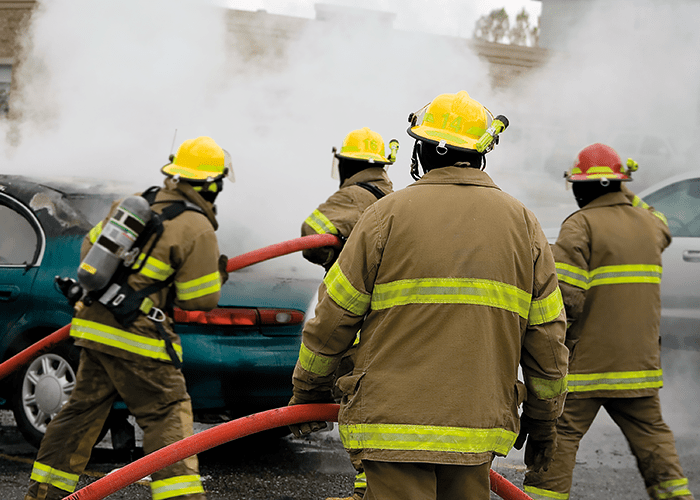
From turnout gear, helmet, gloves and boots, to self-contained breathing apparatus, Personal Protective Equipment (PPE) is designed to protect firefighters from the multiple hazards they face. In such a physical profession, where firefighters must work in bursts of intensive physical activity, how is PPE designed to ensure that they are not overloaded with the weight of the gear, or subjected to additional heat stress? The answer lies in ergonomic design.
Put simply, ergonomics is the study of the work you do, the environment you work in, and the tools you use to do your job. “The goal of PPE design ergonomics is to design personal protection that fits you and the job you are doing” says Dr Richard Graveling, Principal Ergonomist at the Institute of Occupational Medicine (IOM).
2016 is an exciting year for the ergonomics profession. In recognition of the vital role ergonomics plays in the design of PPE, a new “Ergonomics design and evaluation of integrated PPE systems” working group met for the first time last October. Formed by the European Committee for Standardization (CEN), the working group has been set up to represent PPE in all sectors on a European level and will report throughout 2016 on progress.
Applying ergonomics principles to PPE design helps to ensure that it fits properly and doesn’t interfere with work activities. Graveling cites the tragic case of a female police officer, stabbed to death after removing her stab-proof vest because it was getting in the way when she was trying to force entry to a property as part of a raid. “This case highlights the importance of getting it right – and the potential cost of getting it wrong. Studies have shown that PPE which doesn’t fit properly or gets in the way (including clashing with other PPE) is less likely to be worn” he adds.
Janette Edmonds, Principal Consultant Ergonomist at The Keil Centre draws upon her experience designing body armour for the police. “Core ergonomics design principles are based on scientific research in biomechanics, physiology, anthropometry and cognitive psychology” she says. “The issues range from the most efficient and least harmful places on the body to carry loads, to the areas of the body where the skin is least sensitive to compression, and even which way a fastener should fasten” she adds.

Physical effects of PPE on the body
The work of Graveling’s IOM colleagues led by Joanne Crawford revealed that by wearing fire kit, a firefighter’s energy cost of simply moving around increased by 10 to 15 percent. Edmonds echoes this, citing physiological workload, muscular fatigue and strain and the potential for heat stress as key physical effects of wearing firefighter PPE.
Edmonds: “The addition of PPE typically increases the physical workload, biomechanical strain and thermoregulatory requirement on a firefighter’s body. For example, we know that load carriage on the extremities, such as the feet, legs, arms requires more energy, than say load carriage on the hips. So, heavy footwear will require the body to work harder. The work of ergonomists has led to new designs which transfer load to the hips to decrease the strain” she adds.
Firefighters are regularly subjected to intense heat and physical exertion. PPE gear can exacerbate this, adding to the thermal burden. “Fire kit is very good at stopping heat getting in but also stops the heat the firefighter generates from getting out” says Graveling. One of the key findings of the research he and his colleagues conducted at the IOM raised the potential issue of overprotection. “When testing firefighters, we had them stand in front of large heat lamps simulating the heat load if they were working on a grass fire. The body was well protected inside – so much so that the outside of their garments became hot enough to burn your hand when you touched it, but the firefighter was alright. However, the physical effort meant that the firefighter gradually heated up inside”. The series of studies carried out for the Home Office at that time demonstrated that there was a risk that, in seeking to provide the firefighter with more and more protection from the fire, there was a risk of locking in too much body heat (firefighters called this the ‘boil in the bag syndrome’).
One of Graveling’s and his colleagues other projects looked at fire hoods – the balaclava style fabric garment worn to protect the head. Interestingly, heat stress in firefighters wearing the hoods, was not significantly different to those who did not – despite concerns that, as a major avenue for heat loss, covering the head would have an adverse effect. One of the issues raised however, was a resistance from firefighters to cover their ears as many regarded them as heat sensors – when your ears start to burn, get out! Firefighters also raised the concern that their hearing might be impaired, making it harder for them to locate the source of sounds. However, testing revealed that the fire hoods had no significant impact on the firefighters’ sound location. Through this research two human factors issues were addressed and, partly as a result of this work, firefighters are now routinely supplied with fire hoods.

An ageing society
In the UK today, almost a quarter (23%) of workers are 60 years plus, with this figure set to rise to a third (30.7%) by 2020. In the firefighting industry, does our ageing population bear any significance on PPE design?
In Edmonds’ view, the issue is not just about age; it is about the health and fitness of the firefighter. ”If a firefighter has a Body Mass Index (BMI) greater than 25, they would be classified as overweight or obese” says Edmonds. This is challenging when developing the size ranges and material shaping profiles of the garments. Graveling agrees: “It’s a distinction between biological age, chronological age and behavioural age” he says. “There are a lot of older firefighters out there who are perfectly fit and capable and would meet existing fitness standards, however, there are also others where age is catching up with them, and the difficulty is, having a set retirement age is a one size fits all” he adds.
In terms of fitness, a firefighter’s body needs to be capable of carrying the additional load. “A disproportionate body profile if you’re out of shape, can lead to adverse biomechanical load and strain on the muscles and skeletal system that the design was aiming to reduce” says Edmonds.
Taking a police and security perspective, Edmonds expresses the necessity of providing adequate protection where body armour plates overlap. If someone is overweight, ensuring the proper fit poses more of a challenge. If there are gaps, say, at the sides or the abdomen, this could lead to exposure of the body and vulnerability to stabbing or gunshot wound in the case of the protective vests.
This was recognised by the development of a British Standard (BS 8469) on the ergonomics of PPE for firefighters (also written with IOM support). which examines many issues including maintaining protection in different postures.
PPE can only do its job if it is worn, fits correctly, and is fitted properly. Designing, procuring, providing and wearing PPE which has been ergonomically designed to meet the specific needs of workers is vital and helps to ensure that those workers go home uninjured and healthy at the end of the day.
Case Study
When London Fire Brigade needed to select new fire kit, they recognised that ergonomics characteristics were a fundamental feature of such kit. So they decided to include ergonomics testing of the fire kit on offer as part of the selection process. Supported by IOM ergonomists, a volunteer sample of London’s firefighters carried out a series of standard tests, based on BS 8469. Graveling: “Tests covered the fit of the PPE – including when bending and stretching – and the impact of the PPE on a selection of firefighting-related tasks such as rolling out hoses and raising ladders. The results formed a major component of the selection scoring and helped to ensure that the capital’s 5,000 firefighters were equipped with ergonomically the best fire kit on offer” he explains.
For more information, go to www.ergonomics.org.uk
