
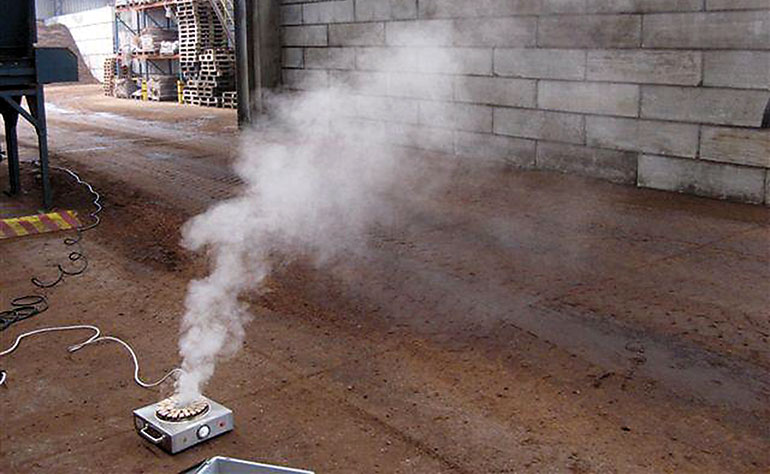
The safety problem of these sites has come back to the fore due to the numerous fires and accidents that have occurred lately. These situations have once again shown how, in order to avoid possible problems of atmospheric pollution as well as land and water pollution, it is necessary to monitor safety with reliable systems and give warnings of the onset of a fire hazard as quickly as possible.
In recent times, fire detection has become increasingly necessary in these sites, and technologies have been sought that can best guarantee safety and prompt detection. Among other things, we found ourselves having to evaluate and face various environmental problems, such as the presence of suspended dust and vapours. And some plants located in warehouses with open sides face consequent critical situations due to fog, humidity and variations in environmental conditions, as well as by the presence of birds.
In fact, the greatest difficulty in these places is to ensure constant disclosure in different conditions and to allow maintenance intervals that do not lead to excessive downtime, with consequent costs for end users, or an interruption in fire-protection coverage.

Precisely to give a safe and quality response to these needs, advanced technology beam detectors are increasingly used in these areas. These models have the characteristic of being able to detect the presence of smoke in the initial phase of a fire or overheating in the environment to be protected due to the presence of a starting fire with the development of heat even in the absence of smoke. This technology, based on a double modulation of smoke and fire detection, guarantees prompt detection even when in the environment to be protected there are materials of different types that may behave in a different ways in the initial phase of a fire, which is the case in a majority of waste and recycling sites.

This technology was first tested directly to protect paper-recycling plants. Then, from this experience, different models have been developed for all applications regarding the storage, recycling and disposal of waste, and also with mixed materials.
If there are problems due to the constant presence of vapours or acid substances, mostly in the storage systems of special chemical and/or toxic materials, the detectors can be inserted in appropriate protective enclosures to preserve their integrity without this causing a decrease in the useful optical range or the settable sensitivity, both for smoke and fire thresholds. The thresholds can be managed by remote control, allowing them to be adjusted (always in the range allowed by the standard) to give the best performance both in detection and in rejection of false alarms.

These linear detectors also have the characteristic of signalling a lowering of the IR signal due to the deposit of dirt or dust, giving a dedicated maintenance-request signal, which when sent to the control and signalling equipment allows accurate management of maintenance. In this mode, the detector remains active and the signalling of any alarm always has priority over that of the maintenance request. The maintenance intervals are greater than for any other detection system, also guaranteeing a saving on plant management costs.
For more information, go to www.setronicverona.com
About the Author

Paolo Borloni joined Setronic in 2003 after 20 years’ experience in fire and security. He is responsible for research and development and the certification of detectors, and assists the project engineer in the choice and correct installation of the beam detectors. He is also a member of Standard Italian organization and CEN TC72.
